Hiring a website design company for small business needs sounds simple until you start getting quotes. One shop wants a few hundred dollars, the next wants ten thousand, and both promise roughly the same thing: a professional site that gets you customers. The gap is real, and so is the risk of paying too much for too little or too little for a site that quietly fails you. This guide walks through what these companies actually do, what a fair price looks like, how to vet one properly, and when a cheaper route makes more sense than hiring at all.
I'll be straight with you from the top. Plenty of small businesses hire a design company and get exactly what they needed. Plenty of others pay for something they could have built themselves in an afternoon, or worse, get locked into a platform they can't leave. Knowing the difference before you sign is the whole game.
What a website design company actually does for a small business
A website design company for small business work usually bundles a few things into one fee: strategy, design, copy, build, and launch. The good ones start by asking about your customers, your competitors, and what you actually want visitors to do. Then they design pages, write or edit the words, build the site, and put it live. Some also handle hosting, domain setup, and ongoing maintenance.
The real value of a strong company is judgment, not just pixels. An experienced team can spot that your offer is confusing, that your prices are buried, or that your best selling point never makes it above the fold. That kind of thinking is worth paying for when your site is a genuine revenue channel.
The catch is that "website design company" covers a huge range. It might be one freelancer working from a laptop, a three-person studio, or a fifty-person agency. The name on the door tells you very little. What matters is the work they show you and the way they answer questions, which is exactly what the vetting section below is for.
Tip: Before you talk to anyone, write down the three things your website must do for your business. Explain what you offer, get found on Google, and capture leads is a common set. If a company can't clearly say how they'll deliver those three, keep looking.
What it costs to hire a website design company for a small business
Prices swing wildly, so treat any single quote as one data point, not the market rate. Here is a rough map of what small businesses actually pay, and just as important, what hides underneath the headline number.
| Provider type | Typical build fee | What is often extra |
|---|---|---|
| Solo freelancer | A few hundred to low thousands | Hosting, ongoing edits, stock photos |
| Small studio | Low to mid thousands | Maintenance retainer, extra pages, revisions past a limit |
| Full agency | Mid thousands and up | Everything billed by scope, strategy add-ons, priority support |
| DIY AI website builder | Low monthly subscription | Usually nothing, hosting and edits included |
For a reality check on agency rates, Clutch's web design company pricing guide (updated September 2026) says most web design projects reviewed on its platform cost less than $10,000, and that shortlisted web design companies typically charge $100 to $149 per hour. The same page puts companies that build on Wix, WordPress, Squarespace, Webflow, or Shopify at $25 to $49 per hour, which is a useful hint: a builder based project should not be priced like fully custom code.
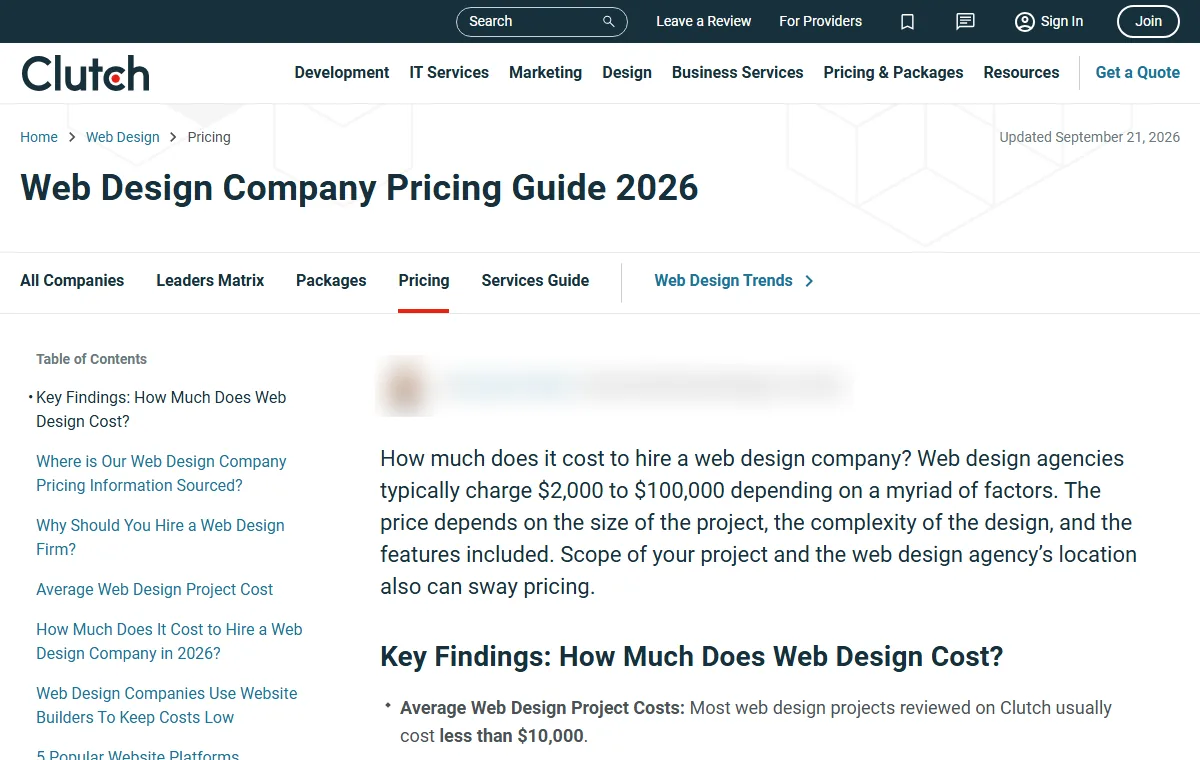
Where the company sits also moves the number. Clutch lists typical hourly rates by country, and the spread is wide:
| Agency location (Clutch, 2026) | Typical hourly rate |
|---|---|
| United States, Canada, Australia | $100 to $149 |
| United Kingdom | $50 to $99 |
| Ukraine, Poland, Spain, Mexico | $25 to $49 |
| India, Philippines | Under $25 |
The build fee is only the sticker price. Add hosting if it isn't bundled, add a maintenance plan or per-change fees, and add the cost of your own time spent briefing and reviewing. A site that costs three thousand dollars to build can quietly cost that much again over two or three years of edits and upkeep. We break the numbers down further in our guide on how much a website costs, and it's worth reading before you approve any quote.
Here's the contrarian take most agencies won't tell you: for a lot of small businesses, the expensive part of the site is the part that adds the least. A custom-coded animation or a bespoke content system looks impressive and rarely changes whether a plumber, a cafe, or a consultant gets more calls. What gets calls is a clear message, a fast page, and an easy way to reach you. You can get all three without a five-figure invoice.

A vetting checklist before you sign anything
Most bad website experiences trace back to skipping the boring questions up front. Run any company through this checklist before money changes hands.
- Portfolio in your world. Ask for live sites they built for businesses like yours, then actually open them on your phone. Slow or clunky work is a preview of yours.
- Callable references. A confident company hands you two or three past clients to talk to. Vague answers here are a signal.
- Written scope. Number of pages, revisions included, what counts as "extra," and the timeline should all be in writing. Verbal promises evaporate.
- Ownership in writing. Confirm you own the domain, the hosting account, and the design files. This is the single most skipped question and the most painful to get wrong.
- Edit process and price. How do you change your hours or add a service after launch? Is it a quick email, a form, a fee, a wait? Get the honest answer.
- SEO basics included. A site that can't be found isn't doing its job. Confirm they handle page titles, structure, and speed. Our primer on website SEO basics shows what to check for.
- Lead capture that reaches you. Where do form submissions go? A contact form that emails an inbox nobody watches is worse than no form. Ideally inquiries land somewhere you already reply, like WhatsApp.
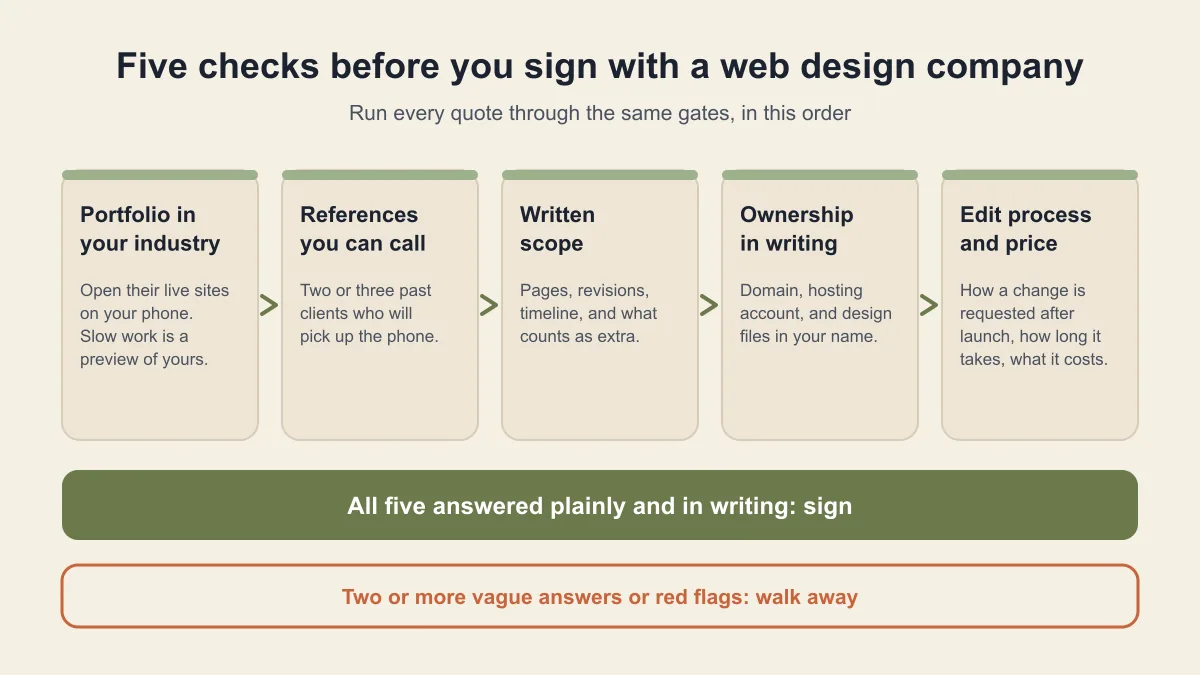
Note: The way a company answers these questions tells you more than the answers themselves. Plain, quick, specific replies signal a team that has done this many times. Defensiveness, vagueness, or "don't worry about that" signals trouble you'll meet again after launch.
Six questions to ask on the first call
The checklist tells you what to verify. These questions are how you get the answers quickly, usually inside a 20 minute call. Ask them in this order and write down what you hear.
- "Who will actually work on my site?" You want names and roles, not "our team." If the person selling is not the person building, ask to meet the builder.
- "Can you send me three live sites like mine, and one client I can call?" Live links prove the work still runs. A callable client proves the relationship survived launch.
- "What exactly is included, and what costs extra?" Push for pages, revision rounds, copywriting, photos, and SEO setup in writing. "It depends" is fine on the call, but not in the proposal.
- "Whose name will the domain and hosting be in?" The only good answer is yours, with your own login.
- "If I want to change my opening hours next month, what happens?" This one question reveals the whole after launch relationship: speed, cost, and attitude.
- "What happens if we part ways?" A confident company explains how you take the site, files, and accounts with you. A nervous one changes the subject.
Compare the answers side by side across two or three companies. The cheapest quote with vague answers is usually the most expensive choice once the second year of edits arrives.
Red flags that should make you walk away
Some warning signs are worth ending the conversation over. Watch for these:
- They won't tell you who owns the site, domain, or files, or they insist you stay on their proprietary platform forever.
- The quote is a single lump sum with no breakdown of what's included.
- Every small edit after launch costs money and time, and they seem happy about that.
- The portfolio is all stock templates lightly reskinned, sold as custom work.
- They promise a top Google ranking by a specific date. Nobody can guarantee that honestly.
- Communication is already slow and confusing during the sales pitch, which is when companies are on their best behavior.
None of these are automatically disqualifying on their own, but two or three together usually mean you'll spend the relationship frustrated. Trust that pattern.
The cheaper route: AI website builders
Here is the part a vetting guide is supposed to skip, and I won't. For a large share of small businesses, the honest answer is that you may not need a design company at all.
An AI website builder takes a one-sentence description of your business and generates a complete, publish-ready site in a few minutes. You edit it by typing what you want changed, "make the headline shorter," "add a pricing section with three tiers," "move the contact form up," with no code and no waiting on someone else's calendar. SEO basics come built in, lead forms on paid plans route straight to your WhatsApp so inquiries land where you already reply, and you can publish to a free subdomain or connect your own custom domain.
The cost difference is not subtle. Instead of a four-figure build fee plus recurring edits, you pay a low monthly subscription that covers hosting and updates. On Forgelo the Starter plan is $9 a month and includes 30 AI generations and edits per day, one custom domain, and WhatsApp lead forms, while the Free plan lets you publish one site on a Forgelo subdomain with 5 AI edits per day. You can see every tier on the pricing page. For a cafe, a workshop, a solo consultant, or a new brand testing an idea, that is often all the website they ever need.
This route also fixes the ownership and edit-speed problems in one move. You control the site, you make changes yourself in minutes, and there's no third party between you and your own homepage. If your needs are standard, this is hard to beat. Our rundown of small business website essentials covers what a site like this should include so you can judge whether the AI route covers you.
How to decide: hire a company or build it yourself
Strip away the noise and it comes down to a few honest questions.
Hire a website design company when you need a genuinely distinctive brand, complex custom features like booking systems or membership areas, a large site with serious information architecture, or you simply do not want to be involved and prefer to delegate the whole thing. In those cases you are buying judgment and custom work, and it's money well spent.
Build it yourself with an AI builder when your budget is tight, you need to be live soon, you expect to update the site often, and your needs are standard. That describes most new and small businesses, and there's no shame in it. A fast, clean site that explains your offer and routes leads to your phone wins real work. The comparison in our AI website builder vs web designer piece walks through the trade-offs in more detail if you're on the fence.
You can also do both over time. Start cheap and fast with a builder, launch this month, get your first customers, and let real data tell you whether a custom company is worth it later. Starting lean closes no doors and buys you information before you spend big.
The bottom line
A website design company for small business needs can be exactly the right call, or an expensive answer to a question you didn't need to ask. Vet any company hard: portfolio in your world, callable references, written scope, clear ownership, and honest edit pricing. Walk away from lock-in and vague quotes. And before you sign anything, be honest about whether your needs are standard enough that an AI builder gets you a live, lead-capturing site this week for a fraction of the price. For most small businesses, the cheapest reliable route is also the fastest, and the worst outcome is paying a premium for a site you could have launched yourself over lunch.