Small business website design services promise a lot: a polished site, done for you, so you can get back to running your business. For many owners that is exactly the right trade. For plenty of others, it is a slow and expensive way to get something they could build themselves in an afternoon. This guide lays out what small business website design services actually cost in 2026, what you get for the money, and where an AI website builder quietly does the same job for a fraction of the price.
There is no single right answer here, and anyone who tells you otherwise is selling something. A busy plumber with cash to spare and zero interest in tech should probably hand the whole thing off. A new bakery owner watching every dollar should probably not. Let's walk through the real options so you can tell which one is you.
What small business website design services actually include
Before you compare prices, understand what you are buying. A full website design service usually covers five things: a discovery conversation about your business and customers, copywriting for your pages, the visual design, the technical build, and the launch. The better services also set up basic SEO and give you a clear plan for making changes after go-live.
The trouble is that scope varies enormously between providers who all use the same words. One "website package" includes hosting, edits, and support for a year. Another stops the moment the site goes live and bills you for every change after that. Two quotes that look identical on price can be worlds apart once you read what happens in month two.
So the first job is not comparing prices. It is comparing scope. Ask any provider three questions before anything else: who writes the copy, who makes changes after launch, and what those changes cost. Their answers tell you more than any portfolio.
Tip: Get the answer to "what does a small edit cost after launch" in writing before you commit. This single line item is where a cheap-looking quote turns expensive, and it is the number most owners never ask about.
What small business website design services cost in 2026
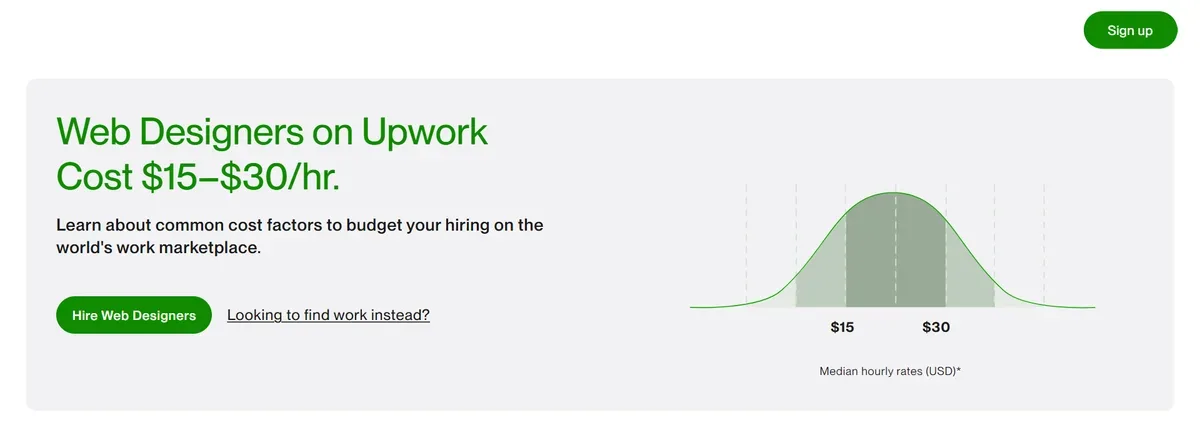
Design services are priced in hours, so the useful numbers are hourly rates and typical project sizes. The figures below come from two published sources that track real hiring: the Upwork web designer cost guide, based on rates on its marketplace, and the Clutch web design pricing guide, updated September 2026 from verified client reviews. Forgelo's prices come from our pricing page.
| Option | Published price | What the number means | Source |
|---|---|---|---|
| Freelance web designer, median | $15 to $30 an hour | Median hourly rates on the marketplace | Upwork |
| Freelancer, basic one-page site | $15 to $40+ an hour | One page, few elements, basic layout | Upwork |
| Freelancer, CMS theme design | $20 to $50+ an hour | WordPress, Joomla, Drupal and similar | Upwork |
| Freelancer, full custom design | $45 to $75+ an hour | Built from scratch with custom code | Upwork |
| Agency working on a site builder | $25 to $49 an hour | Wix, WordPress, Squarespace, Webflow, Shopify | Clutch |
| Web design company, shortlisted | $100 to $149 an hour | Typical rate of firms listed on Clutch | Clutch |
| Web design company, per project | $2,000 to $100,000 | Most projects reviewed cost less than $10,000 | Clutch |
| Forgelo AI website builder | $0, then $9, $19, or $39 a month | Free plan on a subdomain, paid plans add more sites and daily AI edits | forgelo.com |
The spread is the story. The same five-page site can be a few hundred dollars from a freelancer on a builder or several thousand from a firm billing $100 an hour or more. Neither is wrong. They are buying different amounts of strategy, custom work, and hand-holding.
Notice that price and time move together. The more you pay, the longer you usually wait, because human work takes human hours. That is not a knock on agencies. It is just the shape of the trade. If your website is a major revenue channel worth a serious investment, those hours are well spent. If you mainly need to look credible and capture leads, paying agency rates for a five-page site is hard to justify.
For a deeper breakdown of where the money goes over a year or two, our guide on how much a website costs runs the full math, including the ongoing costs people forget at signing.
How to turn hourly rates into a realistic quote
An hourly rate means little until you multiply it by hours. Upwork's guide gives the range: anywhere from 10 hours for a very small design project to several dozen hours for a large custom design with several rounds of revisions. That gives you a quick way to sanity-check any quote you receive.
- Very small one-page design. 10 hours at Upwork's $15 to $40+ band is roughly $150 to $400 or more, before hosting and copy.
- Five-page site from a freelancer on a CMS. Say 30 hours at $20 to $50+ is roughly $600 to $1,500 or more.
- The same site from an established agency. Say 40 hours at Clutch's typical $100 to $149 is roughly $4,000 to $5,960.
The hour counts in the second and third lines are our illustrations within Upwork's "several dozen hours" range, not published averages. Use them to spot outliers. A quote far above the math should come with extra scope you can name, such as branding, copywriting, photography, or custom features. A quote far below it usually leaves something out, often revisions or post-launch support.
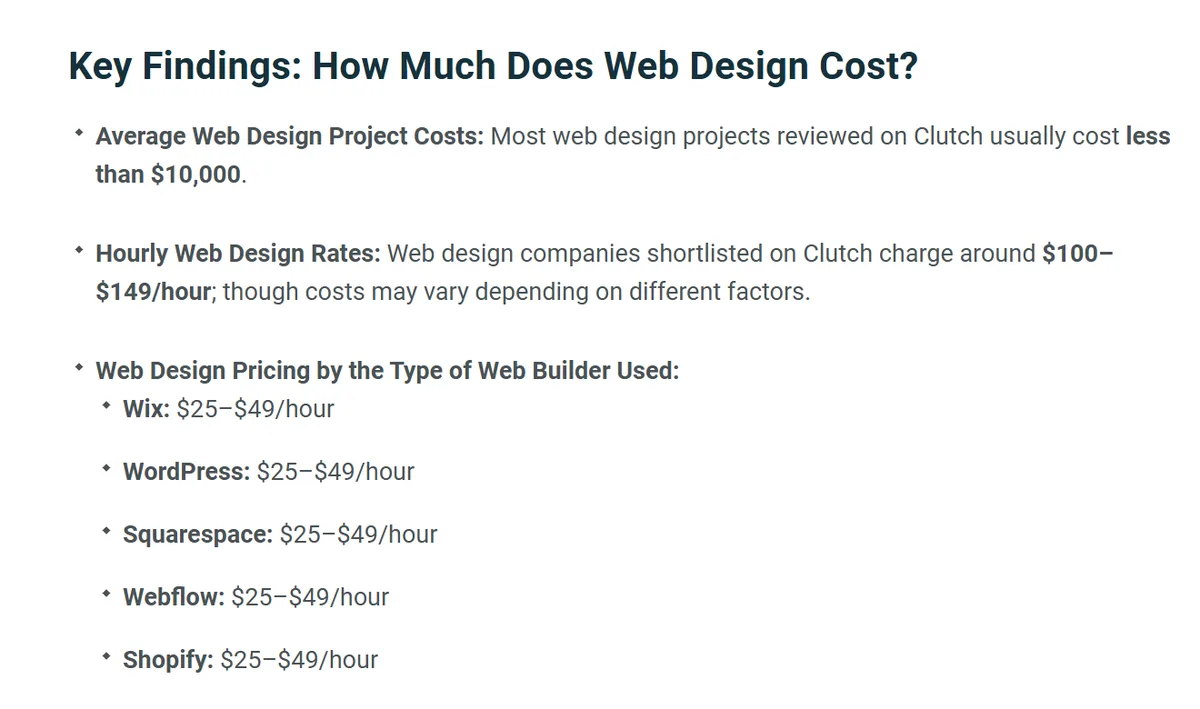
Two more numbers explain why averages mislead. Clutch reports an average web design project cost of $38,105.39 and an average length of 7 months, yet also says most projects on its platform cost under $10,000. A handful of very large builds pull the average up. Location moves rates too: Clutch's table lists typical hourly rates of $100 to $149 in the United States, Canada, and Australia, $50 to $99 in the United Kingdom, and under $25 in India.
The AI shortcut most owners overlook
Here is the option that rarely shows up on a design agency's price sheet, for obvious reasons. An AI website builder skips the quote, the wait, and the hourly billing entirely.
With Forgelo, you describe your business in a sentence and get a complete, publish-ready website in a few minutes. Then you edit it by typing what you want. "Make the headline shorter." "Add a services section with three packages." "Move the contact form to the top." No code, no design software, and no waiting on someone else's calendar. From the Starter plan up, lead forms route straight to your WhatsApp, so inquiries land where you already reply to customers. SEO basics are built in, you can publish to a free subdomain or connect your own custom domain from Starter, and paid plans run $9, $19, or $39 per month, with 30, 100, or 300 AI generations and edits per day.
That daily allowance is the quiet advantage. With a design service, every change after launch is a request, a wait, and often a bill. With an AI builder, changing your hours or launching a promotion takes minutes and does not add a line to an invoice. If you like keeping your site fresh, that difference adds up fast.
The honest limit: an AI builder works from proven patterns, so it produces a clean, professional site rather than a one-of-a-kind brand experience. For a local service business, that is usually more than enough. If you want the full trade-off spelled out, we compared the two paths in detail in AI website builder vs hiring a web designer.
Website design services for small business: matching the option to your situation
The right choice depends less on your industry and more on four things: your budget, how fast you need to be live, how custom you truly need it, and whether you want to make changes yourself.
Choose a freelancer or agency when:
- You need a distinctive brand that cannot look like a template.
- Your site needs complex features like custom booking, memberships, or deep integrations.
- You have a large site with real information architecture to plan.
- You have the budget and genuinely do not want to touch the site yourself.
Choose an AI website builder when:
- You are a small business, freelancer, or solo owner watching the budget.
- You need to be live this week and start getting inquiries.
- You expect to update the site often and want to do it yourself.
- Your needs are standard: clear pages, a way to be found, a way to capture leads.
Most new and small businesses land in the second group. That is not a compromise, it is a match. The bookkeeping firm that just needs to look trustworthy and take calls does not need what the premium furniture studio needs.
Note: Website design services for small business are not a lifetime decision. Plenty of owners launch with an AI builder, win their first customers, then hire a designer later once they know what actually works. Starting cheap and fast keeps every door open.
How to judge a design portfolio in five minutes
A portfolio shows taste, but you are hiring results. Open three sites the provider built, on your phone, and check each one against the questions below. They reveal more than the polished screenshots on the agency homepage.
- Can you tell what the business does within five seconds? If the headline is clever but vague, expect the same on your site.
- Is there one obvious next step? Look for a call, booking, or message button that stays easy to find while you scroll.
- Does the page load quickly on mobile data? A heavy hero video that stalls on a phone is a design choice you will pay for.
- Do the sites look different from each other? If every client gets the same layout with a new logo, you are buying a template at custom prices.
- Are the sites still live and current? Dead links, old prices, or expired domains suggest nobody planned for life after launch.
Our checklist in 10 things every small business website needs covers what the finished site itself should include. Use it as the yardstick for every portfolio you review, and for your own site later.
What to prepare before you contact a design service
The quality of the quotes you receive depends on the clarity of what you send. A one-page brief makes quotes comparable and keeps the project from drifting.
- What the site must achieve. One main goal, such as more booking requests or more calls, and how you will know it is working.
- The pages you expect. A simple list: home, services, about, contact, and anything specific such as a menu or a gallery.
- Your content status. Say honestly whether your text and photos are ready, partly ready or not started, because writing content is often the slowest part.
- Two or three sites you like, and why. Point to the specific thing you like, such as the layout or how prices are shown, rather than the whole site.
- Budget range and deadline. Sharing a range saves both sides from proposals that were never going to fit.
- Who will update the site after launch. This decides which platform the designer should use and how much training or support you need.
Send the same brief to every provider. Differences between their answers then reflect their approach, not gaps in what they were told.
Red flags when you hire a website design service
If you go the agency or freelancer route, a few warning signs are worth taking seriously. Walk away from vague scope, from anyone who cannot tell you who owns the domain and content at the end, and from a portfolio where every site looks like the last one with a new logo dropped in.
Here is the contrarian take: the most expensive part of a website is almost never the design fee. It is the months you spend not-live while a project drags through revisions, plus the slow bleed of per-change edits over the years that follow. A site that launched today and is merely good beats a perfect one still stuck in someone's inbox. Weigh the total cost of waiting, not just the number on the quote.
How to decide, and why you can start today
Sort your situation into one of three buckets. If you need something genuinely custom and complex and you have the budget, hire a professional service and pay for the judgment. If you want a middle path, a freelancer can deliver solid work for less than an agency. And if you want speed, control, and predictable costs, start with an AI builder and upgrade only if the business demands it.
For most small businesses, that third path is the sensible first move. You can be live before an agency would even send a proposal, and you can always graduate to a custom build later with real data in hand instead of guesses. Compare the current plans on our pricing page and see how far a few dollars a month actually goes.
The worst choice is no choice. Pick a lane, get something real in front of customers, and let the business tell you when to invest more.