Hunting for a free website domain makes total sense, especially when you're just starting out and every dollar counts. The good news: there are legitimate ways to get an address for your site without paying upfront. The less fun news: not everything labeled "free" is actually free or safe, and some options can quietly hurt your business if you don't know the difference. In Indonesia people search for this as "domain website gratis," and the trade-offs are the same everywhere. Let's break down the safe sources, the risks nobody mentions, and when you genuinely need to buy your own.
Here's the short version. If your goal is to launch fast and test an idea, a free subdomain from a reputable platform is more than enough. If you're chasing a flashy .com for free through a sketchy site, you usually pay in other ways: injected ads, a domain that can vanish, or a reputation that's hard to build. Let's take it slowly.
What a "free website domain" really means
"Free" in the domain world has a few layers, and people mix them up constantly. Three different things all get called free:
- Free subdomain: an address like
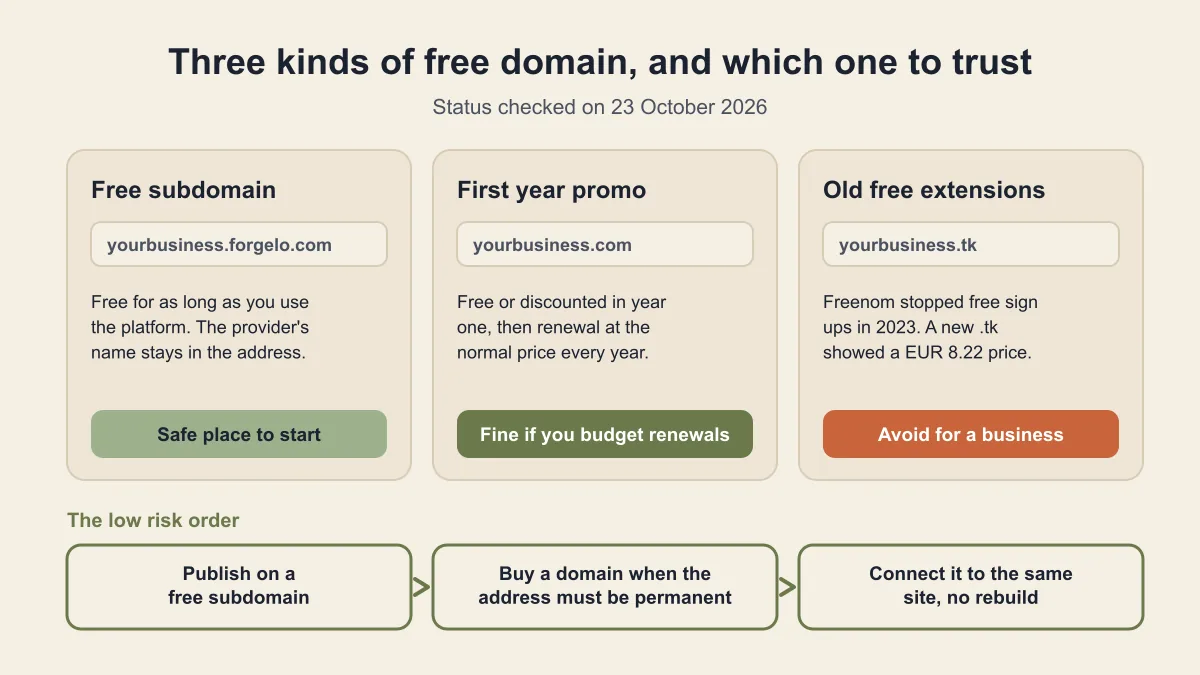
yourbusiness.forgelo.comoryourbusiness.platform.com. You're a guest on the provider's parent domain. This is genuinely free and safe, though the provider's name rides along in your address. - Free TLD domain: extensions like .tk, .ml, or .ga that used to register for nothing through Freenom. They look like "real" domains but carry a rough reputation, and as the next section shows, the free part is mostly gone.
- First-year-free paid domain: many hosts throw in a free .com for a year when you subscribe to a plan. That's not permanent free, it's a promo. Year two, you pay.
Telling these apart matters because the risks differ wildly. A free subdomain is honest and durable. A free TLD is a subtle trap. A first-year promo is legitimate, but you have to run the long-term math.
Where to get a free website domain safely
These are the options you can actually use without regret later:
1. A subdomain from your website builder. If you build your site with a modern builder, you usually get a free subdomain the moment you publish. Forgelo, for example, gives every site a free subdomain, so you can go live and start sharing the link the same day without buying a domain first. It's the safest way to begin.
2. A blog or portfolio subdomain. Free blogging and portfolio platforms also hand out subdomains. Great for writers, photographers, or anyone who just needs one page for people to find.
3. A first-year-free domain from a hosting plan. If you already intend to pay for hosting, the free .com for a year is a decent bonus. Just go in knowing there's a renewal fee next year.
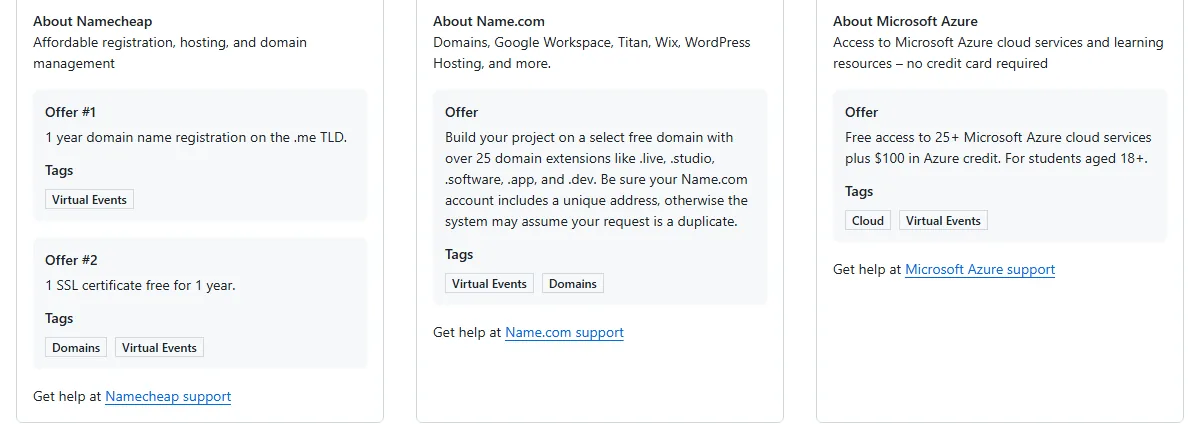
4. Student and developer packs. The GitHub Student Developer Pack is the best known example. On 23 October 2026 its offer list included a one year .me registration from Namecheap, one standard .TECH domain free for one year, and a select free domain from Name.com across more than 25 extensions such as .live, .studio, and .app. You need an approved student account to redeem them, and each one renews at the normal price after the first year.
Note: For most small businesses just getting off the ground, a free subdomain from your builder is the best starting point. You lose nothing by beginning at yourbusiness.forgelo.com, and you can attach your own domain any time without rebuilding the site.
What happened to Freenom and the free .tk
Most older articles about free domains point to Freenom, the company that gave away .tk, .ml, .ga, .cf, and .gq names for years. That advice no longer holds. In March 2023 Freenom stopped accepting new registrations, days after Meta sued it over domains used for phishing, according to KrebsOnSecurity. The same report notes that those free extensions had long been a favorite of spammers and phishers.
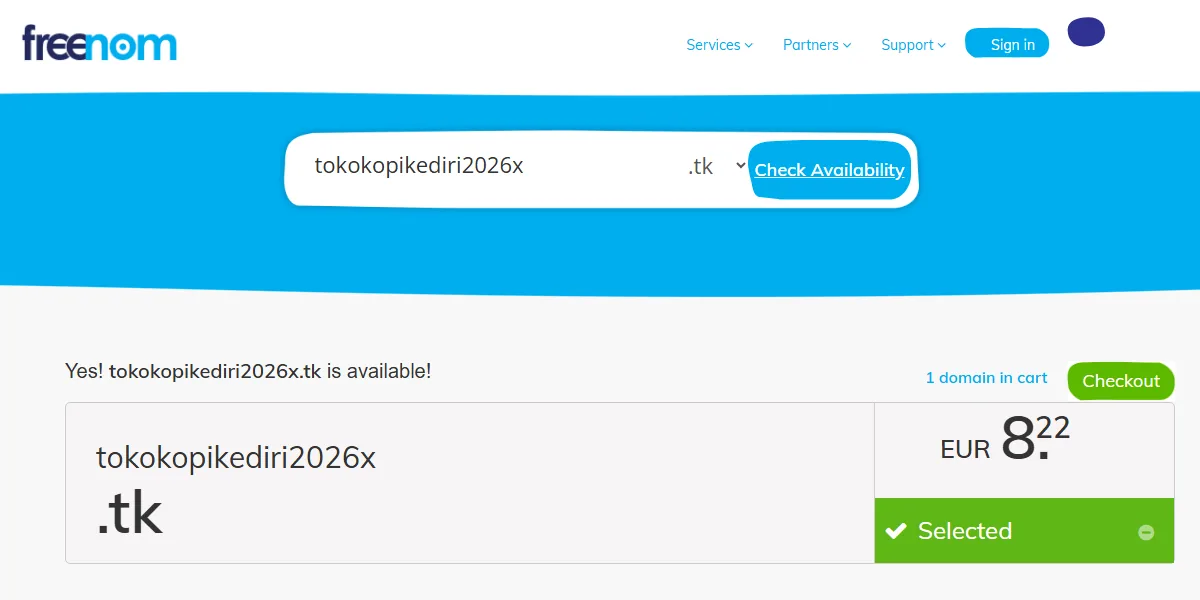
Freenom's website is reachable again, so we tested it on 23 October 2026. A search for an available .tk name returned a price of EUR 8.22, not zero. In other words, the classic "free .tk" is no longer free, and the reputation problem that came with it has not gone away.
Free vs paid: the honest comparison
To make it easy to see, here it is side by side.
| Aspect | Free subdomain | Free TLD (.tk etc) | Paid .com |
|---|---|---|---|
| Cost | Free forever | No longer free at Freenom (.tk showed EUR 8.22) | About $11 a year at Porkbun |
| Looks professional | Fine, provider tag attached | Often flagged as spam | Yes |
| Can be revoked | Rarely | Yes, it has happened | No while renewed |
| Good for business email | Limited | Not recommended | Yes |
| Customer trust | Okay for a start | Low | High |
| When to use it | Validation, testing | Best avoided | A serious business |
Look at the middle column. A free TLD is the most tempting because it "looks like a real domain," yet it's the riskiest. Which brings us to an opinion that might be unpopular.
The hidden risks of a free website domain
This is the part the "free domain" sellers skip. My contrarian take: a free TLD domain is often worse than having no domain at all. Here's why:
- Reputation is guilt by association. Free TLDs were used en masse for spam and phishing for years. Email filters and browsers grew suspicious of those extensions, and your honest site inherits that suspicion.
- It can disappear without warning. Because you don't truly own a free domain, the provider can deactivate it over a complaint, a policy change, or simple inactivity. Picture your business cards and ads already out there, then the address goes dark.
- Professional email is a headache. Sending mail from a low-reputation free domain often lands in spam. Email to customers matters too much to gamble.
- SEO gets no bonus and can take a hit. A free domain doesn't automatically tank your rankings, but if the extension is already flagged as shady, you start from a harder position.
Tip: Before you fall for a free TLD, ask one simple question: if this address died next week, how much would it cost me? If the answer is "a lot," that's the sign you already need a paid domain, or at least a subdomain from a stable provider.
With a free subdomain from a clear builder, these risks are far smaller. A trustworthy provider won't yank your address on a whim, and your subdomain doesn't share a bad reputation with spam sites.
What a paid domain costs after the free period
"Free" usually ends in year two, so it helps to know the real number you are deferring. These are list prices from the registrars' own pages, checked on 23 October 2026. Prices change with promos, so confirm at checkout.
| Registrar and extension | First year | Renewal per year |
|---|---|---|
| Porkbun, .com | $11.08 | Same everyday price, no separate first year rate |
| Rumahweb, .com | Rp 137,000 (promo) | Rp 219,000 |
| Hostinger Indonesia, .com | Rp 109,900 (with a 3 year term) | Rp 209,900 |
| Hostinger Indonesia, .id | Rp 210,900 | Rp 252,900 |
The pattern is the point. A first year promo can look almost free, but the renewal is the number you will pay every year after. Budget for the renewal price, not the banner price.
How to check a "free domain" offer in five minutes
Before you accept any free domain, run it through these quick checks:
- Read the renewal price. If the offer is "free for one year," find the year two price on the same page. No price shown is a warning.
- Check who owns it. You should be the registrant, with your own login at the registrar. A domain registered in a provider's name is a rental.
- Search the extension's reputation. Type the extension plus "spam" into a search engine. Extensions with a phishing history make email and trust harder.
- Look for a transfer path. A legitimate domain can be transferred to another registrar. If the terms forbid it, you are locked in.
- Test the site address. If it is a subdomain, open it on your phone and check that it loads over HTTPS without warnings.
When free is fine, when you must buy
This is the actual decision. There's no single answer, only conditions.
A free (sub)domain is fine when:
- You're still testing an idea and aren't sure the business will stick.
- You need something to share this week, not next month.
- Your site is one simple page: profile, contact, and a WhatsApp button.
- Your budget is truly zero and you plan to upgrade later.
You must buy your own domain when:
- You've printed cards, banners, or you're running paid ads. The address has to be permanent.
- You want email on your own domain, like hello@yourbusiness.com.
- Your customers judge credibility by the web address, think B2B clients or professional services.
- You're building a long-term brand and don't want a provider's name attached to your address.
A concrete example. A new coffee shop testing a menu through one promo page? A free subdomain is perfect. A catering business already getting steady orders and starting to run ads? Buy the .com, don't cut corners. An online clothing store emailing receipts to customers? You need your own domain so those messages don't land in spam.
How to start: free subdomain now, custom domain later
The good news is you don't have to choose once and forever. The cheapest, safest order is staged.
Start by building your site and publishing to a free subdomain. With an AI builder, you just describe your business and the site is generated in a few minutes, and paid plans add a lead form that routes straight to WhatsApp. On Forgelo the Free plan publishes one site on a Forgelo subdomain with 5 AI edits per day, and the Starter plan ($9 a month) adds one custom domain. You go live, share the link, and see if anyone reaches out. If you've never done it, our guide to the essentials of a small business website covers what actually matters.
Once the idea proves out, buy a .com and connect it. On the right platform, switching from a subdomain to a custom domain doesn't mean rebuilding anything. The content stays; only the address gets an upgrade. With Forgelo you can publish to a free subdomain or a custom domain, and move between them without drama. Check the pricing for the plan that fits. If you want to sanity-check the numbers first, our breakdown of how much a website costs puts the whole budget in perspective, and our website SEO basics guide covers what it takes to get found.
Note: Don't delay your launch just because you haven't bought a domain. A live site on a free subdomain beats a perfect one still in your head. The address can be upgraded; lost time can't.
The takeaway
A free website domain is real and useful, as long as you know which kind you're getting. A free subdomain from a clear provider is the best way to start at no cost: safe and upgradable whenever. A free TLD dressed up like a free .com is usually a trap that swaps upfront cost for downstream risk. First-year domain promos are legitimate, provided you count the renewal.
The practical rule is simple: use free for validation, buy your own domain the moment the business gets serious and your address has to be permanent. Start where you are, launch something real, and upgrade the address when the business actually asks for it.