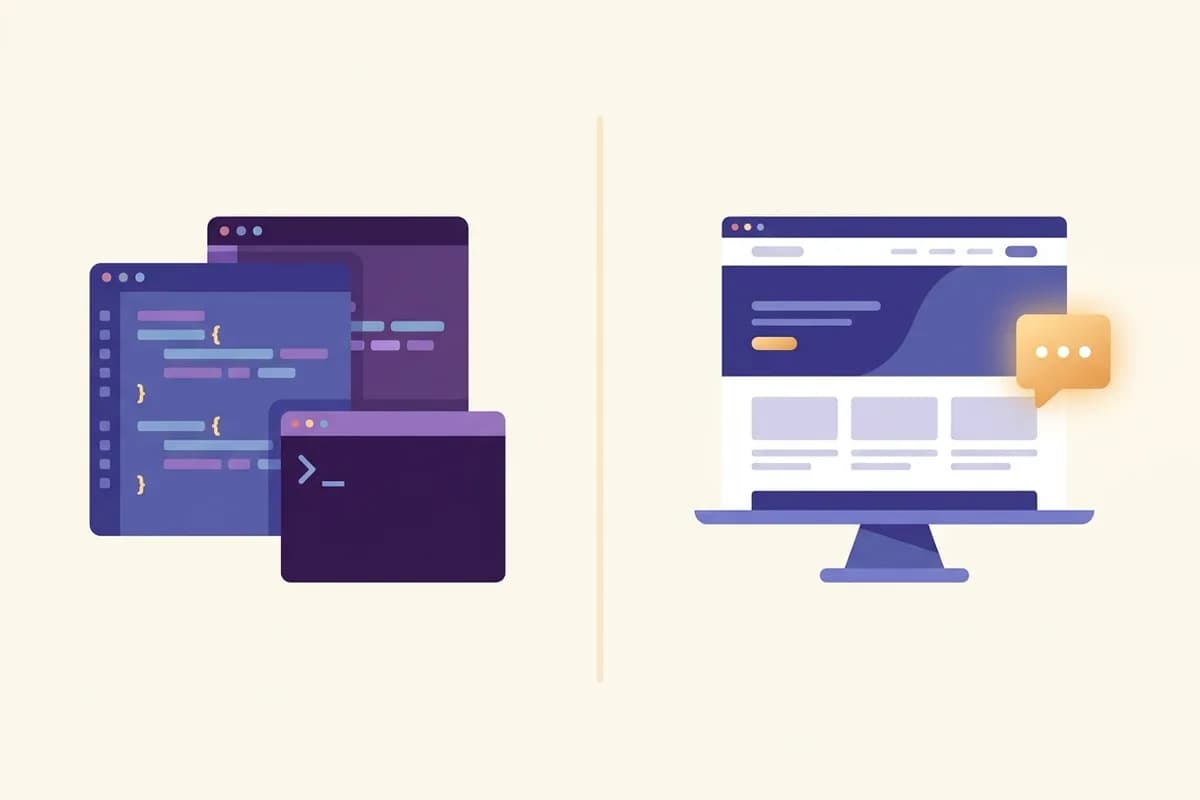
Here's the short version. v0 and Bolt generate code: React components, full-stack apps, real repositories a developer refines and ships. Forgelo generates a finished website: pages, copy, SEO, and a live URL a business owner can keep reshaping by typing what to change. All three start with a prompt. The difference is what lands in your hands afterwards, source code or a published site. If you are a developer, or you have one, v0 and Bolt are superb. If you are not, Forgelo is the one built for you.
Respect first: v0 and Bolt are two of the most impressive AI products of this wave. v0, from Vercel, generates production-grade React and Next.js that professional teams actually ship. Bolt, from StackBlitz, runs a full development environment in your browser and turns chat into working full-stack apps. Nothing in this comparison disputes any of that. The question is narrower and more practical: which tool gets a non-developer to a working business website?
What is Forgelo?
Forgelo is an AI website builder for people who want the website, not the codebase. You describe your business in a sentence or two. A few minutes later there's a complete site, structure, copy, images, live on a free subdomain.
From there you never open an editor or a repo. You keep shaping the site by talking: "shorten the hero headline," "add a testimonials section with three quotes," "make the contact section lead with WhatsApp." Forgelo rebuilds just the section you named and leaves the rest alone. How it works walks through the loop.
SEO basics, titles, meta descriptions, schema, sitemap, ship with every site, and lead forms route straight to WhatsApp, where small businesses actually answer.
What are v0 and Bolt?
v0 is Vercel's AI assistant for building user interfaces and, increasingly, full applications. You prompt it, it generates React/Next.js code with shadcn/ui components, and you refine in chat or its Design Mode before pushing to GitHub and deploying, naturally, on Vercel. Output quality is genuinely production-grade, which is why design-conscious product teams adopted it fast.
Bolt comes at it from the runtime side. StackBlitz spent years making a full dev environment run in the browser, and Bolt puts an AI agent inside it. You chat, it scaffolds a real full-stack app, installs packages, runs it live, and you can drop into the code editor at any point. For prototypes and MVPs it's remarkably capable.
Notice what both descriptions assume: that you can read an error message, resolve a dependency, wire up a domain, and own a deployment. For their intended users that's trivial. For a bakery owner it's a wall.

Forgelo vs v0 vs Bolt at a glance
| Forgelo | v0 | Bolt | |
|---|---|---|---|
| Output | Published business website | React/Next.js code | Full-stack app code |
| Built for | Non-developers, SMBs | Developers, product teams | Developers, founders |
| First result | Live site in a few minutes | Component/app code in minutes | Running app in minutes |
| Editing | Describe the change, section rebuilds | Re-prompt or edit code | Re-prompt or edit code |
| SEO | Built into every site | You implement it | You implement it |
| Lead capture | Forms to WhatsApp, built in | You build it | You build it |
| Hosting and domain | Included, one click | You deploy (Vercel) | You deploy |
| Code ownership | No code to manage | Full code ownership | Full code ownership |
Features and pricing on all three change quickly. Treat this as a mid-2026 snapshot and verify against current pricing pages.
The real question: who finishes the job?
Marketing pages for AI tools all show the same magic moment: a prompt becomes something working. But a business website is not done when something renders. It's done when it's on a domain, findable on Google, and collecting leads while you sleep.
With v0 and Bolt, the distance between "renders" and "done" is developer work. Deploying, connecting a domain, adding meta tags and schema, wiring a form to something that notifies you. None of it is hard for a developer. All of it is a maze for everyone else. The honest pattern we've seen: a non-technical founder has a thrilling first hour with a code tool, then the project quietly dies at deployment or the first cryptic error.
Forgelo's entire design is to make "renders" and "done" the same moment. Generation ends with a live URL. SEO defaults are already applied. The lead form already routes to your WhatsApp. There is no deployment step because deployment isn't your job.
If you have a developer on hand, this section matters less, and the code tools' flexibility starts winning. That's a real fork in the road, not a flaw in either side.
Editing: re-prompting code vs reshaping sections
All three tools let you iterate in chat, so the difference is subtler and worth spelling out.
In v0 and Bolt, iteration operates on code. Ask for a change and the AI edits files. Usually that works. Sometimes it breaks something two components away, and you either read the diff, which assumes you can, or re-prompt and hope. Developers absorb this loop easily because they can always drop to the editor and fix things by hand. That escape hatch is the product working as intended.
Forgelo has no code layer to fall through to, so iteration is constrained by design: you name a section, describe the change, and that section is rebuilt in place. "Make the pricing section three columns." "Rewrite the about section, warmer, mention we're family-run." The blast radius of any edit is one section, which is precisely what makes the loop safe for someone who couldn't debug a regression.
Our honest read: constrained editing is less powerful and far more predictable. For an app, you want the power. For a business site an owner maintains alone, predictability wins, we've written more about that trade-off in how AI generates a website.
Credits, tokens, and the cost of iterating
One practical thing that surprises non-developers on code tools: pricing meters. As of July 2026, v0 Plus costs $30 per user per month and Bolt Pro costs $25 per month, while heavy iteration consumes credits or tokens and complex sessions can burn through an allowance faster than expected. Developer forums are full of "spent my whole month's tokens rebuilding one page" stories. Not a scandal, metered AI is legitimate, but a real budgeting consideration if your working style is fifty small tweaks.
Forgelo starts free, you can generate and publish on a free subdomain before paying, and paid plans are priced for the site-owner pattern: lots of small conversational edits over months. Current numbers on the pricing page.
The comparison to actually run: not sticker price, but cost until your site is live, found, and generating leads, including anything you'd pay a developer to finish what the code tool started.
SEO and leads: the invisible 20 percent
We keep hammering this because it's where non-developer projects on code tools fail silently. A site with no titles, no meta descriptions, no schema, and no sitemap doesn't error, it just never shows up. A contact form wired to nothing doesn't complain, it just loses every lead.
v0 and Bolt can produce all of this if you ask precisely and verify the output, which requires knowing what to ask for. Forgelo treats it as non-negotiable defaults on every site: clean metadata, structured data, sitemap, fast pages, and a lead path into WhatsApp. Boring, invisible, and exactly the part a business can't afford to get wrong.
Which should you choose?
Choose v0 if:
- You're a developer or product team building real UI or apps
- You want production-grade React/Next.js you fully own
- Design quality of generated code matters to you
- Deploying on Vercel is your happy path anyway
Choose Bolt if:
- You want to prototype full-stack apps at conversation speed
- You're comfortable dropping into code when the AI misses
- You're building an MVP or internal tool, not a marketing site
Choose Forgelo if:
- You want a business website, live, findable, collecting leads
- You never want to see code, deployment, or hosting settings
- You'll keep editing over time and want changes to be safe sentences
- WhatsApp is where your customers actually talk to you
Comparing against mainstream builders too? Read Forgelo vs Wix and Forgelo vs Durable, or zoom out with our best AI website builders in 2026 guide.
The takeaway
This is the rare comparison where "it depends" is genuinely the answer, because the three tools aren't competing for the same person. v0 and Bolt are outstanding at giving developers superpowers, and if you can finish what they start, they're a joy.
Forgelo exists for everyone who can't, or doesn't want to. Describe your business, get a complete website in a few minutes, already published, already SEO-ready, already routing leads to WhatsApp. Then just keep talking to it for as long as you're in business.
Start on the free plan and run the only test that matters: get to a live site, then ask for a change.