Renters research on their phone long before they call anyone. They search "car rental" plus a city, open the top three to five results, compare fleets and prices, then message whoever looks most trustworthy. If your business doesn't show up looking sharp on that screen, you lose before you ever get to quote. That is what a good car rental website is really for: not a pretty page, but a fleet catalog, honest pricing, and a booking path that gives a stranger enough confidence to send the first message.
The good news is you no longer have to hire an agency to get one. This guide covers what a car rental website must include, why the fleet catalog and WhatsApp booking are the two features that decide everything, and when it makes more sense to build it yourself with AI than to pay for a slow, expensive custom build.
What a car rental website must include
A rental business sells two things at once: the right vehicle and a sense of safety. People hand over real money to a business they've never met, so every element on your site should chip away at that hesitation. Before you think about design, make sure your pages answer the basic questions running through a renter's head.
- Which vehicles are available, with real photos, not manufacturer stock shots.
- Clear rental rates, split between self-drive and with-driver, and by day, week, or month.
- Your service area, the city and surroundings, plus whether you do airport pickup or out-of-town trips.
- Short rental terms, like deposit, ID, or license requirements, so there are no surprises later.
- An easy way to book, ideally one button that opens WhatsApp directly.
It sounds simple, yet most car rental websites fail right here. They install a slick photo slider and forget to list prices, forcing people to message just to learn the daily rate. Every small bit of friction like that cuts the number of people who actually reach out.
Tip: Publish your prices even if you worry they look high. Serious renters value transparency, and anyone who bolts at the number was never your customer. A page without prices only filters out the people who were ready to pay.
The fleet catalog is the heart of a car rental website
If one section decides whether a car rental website works, it's the fleet catalog. This is not a plain photo gallery. It's a storefront that works while you sleep, and how you build it determines whether a visitor pictures themselves driving that car or closes the tab.
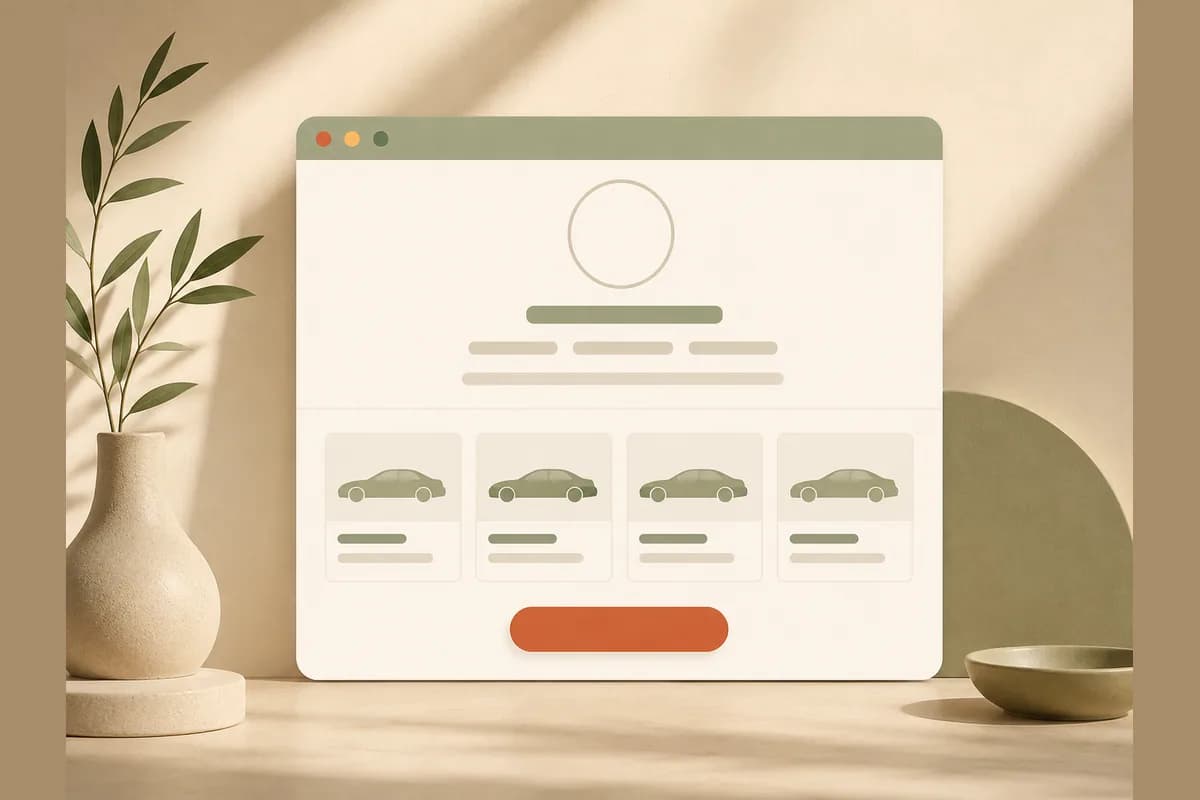
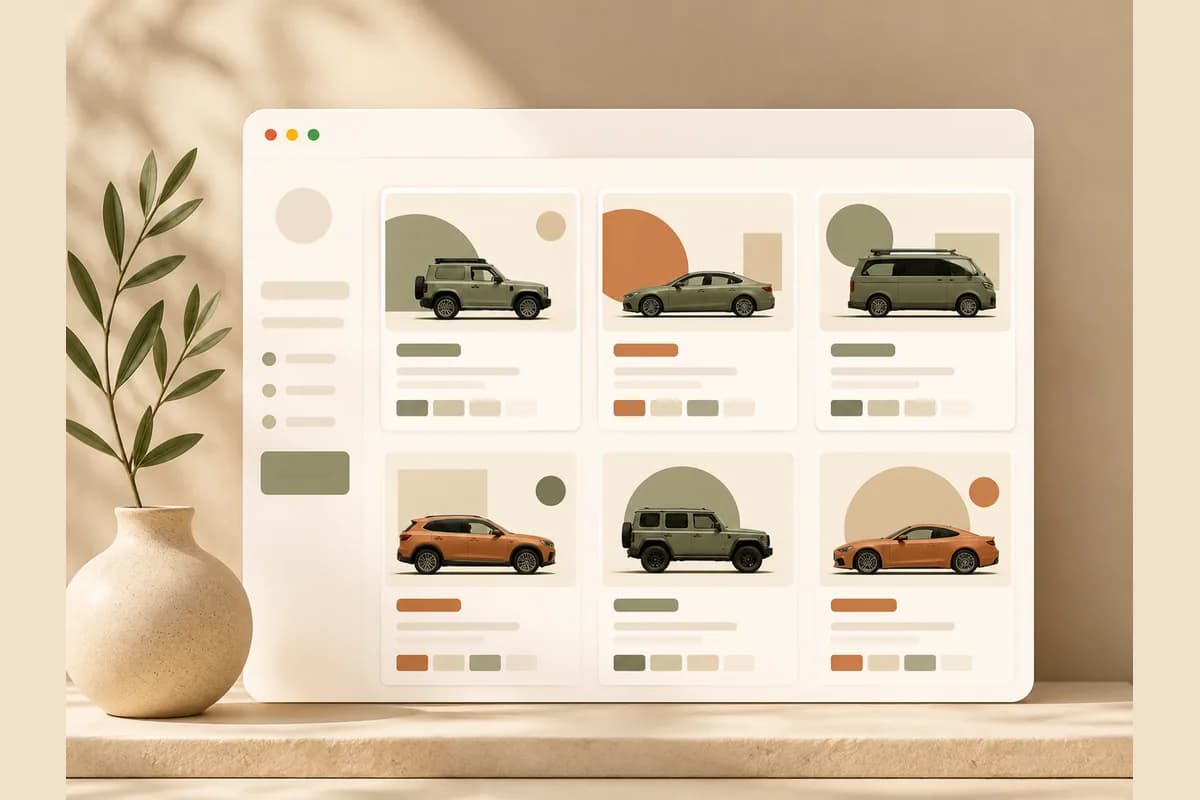
A good catalog treats each vehicle like a product. For every unit, show at least the name and year, passenger capacity, transmission, rate by category, and one clean photo. Group the fleet so it's easy to scan, say family MPVs, fuel-sipping city cars, luxury cars for events, or vans for groups. Someone who needs a compact for a road trip and someone who needs a premium sedan for a wedding arrive with very different intentions; a grouped catalog helps both find their vehicle in seconds.
The overlooked part is updates. A rental fleet changes constantly: cars come in, cars leave, rates rise during holiday season. If every change means waiting on a vendor and paying a revision fee, your catalog slowly goes stale, and a stale catalog is worse than none. A renter who shows up expecting a car that no longer exists leaves disappointed.
This is where the way you build it matters. With a tool that lets you edit by typing plain instructions, adding a new car is as easy as writing "add a 2024 seven-seater SUV, automatic, 55 dollars per day self-drive." A catalog that's easy to maintain stays accurate, and an accurate catalog is the one that closes sales.

WhatsApp booking: turning browsers into bookings
For a huge share of rental businesses, the booking decision ends in a chat. People want to ask about date availability, negotiate duration, and confirm terms before they transfer anything. Forcing them through a rigid online payment form often kills the intent instead. So the goal of a car rental website isn't to finish the transaction on the site; it's to move the conversation to where you close best.
The cleanest way to do that is a lead form whose results land straight in your WhatsApp. A visitor picks a car, fills in dates and duration, and hits send. Instead of vanishing into an inbox you rarely open, the details arrive as a WhatsApp message you can reply to from your phone within minutes. Reply speed is a weapon; renters usually contact several rentals at once, and the one who answers first often wins the booking.
Forgelo handles this out of the box: every form you place routes leads straight to WhatsApp, so inquiries land in the app you already keep open all day. If you want to go deeper on the tactics, our guide on turning visitors into WhatsApp leads breaks down how to write buttons and forms people actually click.
Note: Don't rely on a single floating WhatsApp button in the corner. Put a booking prompt right next to each car in the catalog, at the moment a renter's interest peaks. The closer the button is to the vehicle they're looking at, the more likely they press it.
Hiring a service vs building it yourself with AI
Not long ago, having a car rental website meant hiring an agency, waiting weeks, and paying again every time you wanted to change a rate. Now there's a second path: build it yourself with an AI website builder. Both are legitimate, but they fit different situations. Here's the honest comparison.
| Factor | Hiring an agency | Building it yourself with AI |
|---|---|---|
| Upfront cost | Hundreds to thousands | Small monthly subscription |
| Time to launch | Two weeks to two months | First site in a few minutes |
| Catalog and price updates | Submit a change, wait, often billed | Type the change, done |
| Technical skill needed | No, but depends on vendor | No, just describe it |
| Day-to-day control | With the vendor | Entirely yours |
| Best for | Complex booking systems, custom integrations | Catalog + WhatsApp booking, most rentals |
Take a rental with ten vehicles in a mid-sized market. The needs are clear: a tidy catalog, transparent prices, and a booking button to WhatsApp. For needs like that, paying thousands and waiting two months is hard to justify. You can get an equal, often fresher result by building it yourself this afternoon and redirecting the leftover budget into ads or another car.
When does hiring still make sense? When you need a booking system with real-time availability, deep payment integration, or a genuinely bespoke brand look for a premium rental. If that's not you, and for most local rentals it isn't, an AI website builder is usually the cheaper, nimbler call. It's the same logic we cover in our breakdown of what a website really costs.
Here's a slightly unpopular opinion: the "expensive custom" car rental site often loses to the simple one that's fast and accurate. Renters don't care about clever animations. They care that the car they want is available, the price is fair, and they can book in two taps. Simple that works beats fancy that's slow.
Local SEO: getting found when people search your city
Even the prettiest website is useless if nobody finds it. For car rentals, almost every search is local: "car rental downtown," "self-drive car hire near the airport," "van rental" plus a city. Your job is to convince search engines your business is the best answer for that area.
A few fundamentals that help:
- Name your city and service area explicitly in page titles, not just the footer.
- Fill the catalog with real vehicle names and prices, because people search for specific models, not just "car rental."
- Create separate pages for distinct services when relevant, like with-driver, self-drive, or airport transfers.
- Make the site fast on phones, since most prospects open it from a mobile on the go.
The good news is that a solid AI website builder handles most of the technical SEO groundwork automatically, so you can focus on the content. If this is new to you, start with the basics of website SEO to understand what actually moves rankings before you spend on tricks you don't need.
Cost and time: the honest math
Let's talk numbers plainly. A car rental website from an agency commonly runs from a few hundred dollars for a simple package up to several thousand for one with a booking system, plus annual hosting and per-change fees. The timeline usually runs two weeks to two months depending on the vendor's queue and how fast you supply materials.
The AI website builder path flips that math. With Forgelo, you describe your business in one sentence and a publish-ready site comes out in a few minutes. The cost is a monthly subscription that already covers hosting, unlimited edits, and built-in SEO. Publish free to a subdomain first to test the market, then attach your own domain when you're ready. If you want to see the plans, check Forgelo pricing.
The hidden cost people miss is the cost of being slow. Every week without a website is a week renters pick a competitor who's easier to find. Speed to launch isn't just about saving time; it's about how many bookings you don't miss.
Mistakes that leave a car rental site empty
Most quiet car rental websites aren't quiet because of bad design; they're quiet because they skip the fundamentals. A few of the most common traps:
- No listed prices. People assume a hidden price is a high one, then leave for a competitor who's upfront.
- Weak photos. Real, clean, well-lit shots of your actual cars are far more convincing than generic manufacturer stock.
- Hard-to-find contact. If a renter has to hunt for how to reach you, many give up halfway.
- A stale catalog. Showing cars that are gone or old rates disappoints renters, and they don't come back.
- Heavy on mobile. A slow site loses visitors before the first screen finishes loading.
Notice the pattern: nearly all of these are about trust and ease, not aesthetics. If you're just getting started, our guide on the essentials every small business site needs closes these basic gaps before you launch.
The takeaway
A car rental website comes down to two things: showing your fleet honestly and making booking as easy as sending one chat. A tidy, accurate catalog answers a renter's questions, a WhatsApp button moves them to where you close, and local SEO makes sure they find you first.
You don't have to pay a fortune or wait months for that. If your needs are a catalog plus WhatsApp booking, and for most rentals they are, building it yourself with Forgelo gets you a site that launches faster, costs less to maintain, and stays fully under your control. Describe your business, publish today, and let your catalog work while you're out delivering a car to the next customer.