The Leadpages landing page builder has been a fixture of the marketing world for over a decade, and that longevity is not an accident. It helped popularize the idea that a landing page is a conversion machine, not just a pretty page. In 2026, though, the question has changed. It is no longer "which drag-and-drop builder should I use?" but "should I be dragging blocks around at all when AI can generate the whole page, and the whole site, from a sentence?" This review takes an honest look at what Leadpages still does well, where it shows its age and its price tag, and when an AI-first alternative is simply the smarter buy.
Quick framing before we start: I think Leadpages is a good product. This is not a takedown. But good for whom is the real question, and the answer is narrower than the marketing suggests.
What Leadpages gets right
Leadpages earned its reputation on one thing: pages built to convert. The template library is large and organized around campaign goals like lead capture, webinar registration, sales, and thank-you pages. Templates are sorted by conversion performance rather than just looks, which is a genuinely useful way to choose a starting point.
The drag-and-drop editor is stable and predictable. Sections snap into place, mobile views are handled sensibly, and you rarely fight the tool. Add the Leadmeter, a built-in assistant that scores your page against conversion best practices as you build, and you get guardrails that stop beginners from shipping obviously weak pages.
Then there is the conversion toolkit around the pages themselves: pop-ups, alert bars, and A/B split testing. For marketers running paid traffic who want to squeeze more out of every click, these are real, practical tools. Integrations with the usual email marketing platforms and CRMs are mature and well documented.
Tip: If you already run email-driven funnels with steady paid traffic, the case for Leadpages is strongest. Its whole design assumes you have traffic to test against and an email list to feed.
Hosting is included, pages load fast, and the product has been around long enough that you will find answers to almost any question. Stability counts for something, and Leadpages has it.
Where the Leadpages landing page builder hits its limits
The first limit is scope. The Leadpages landing page builder is exactly what the name says: a landing page tool. It technically offers site building, but the product's center of gravity is the standalone campaign page. If what your business actually needs is a complete website with a homepage, service pages, a blog, and an SEO structure that can rank on Google, you will feel the ceiling fast. Many small businesses buy a landing page tool and then realize they still need a website, which means paying for two products.
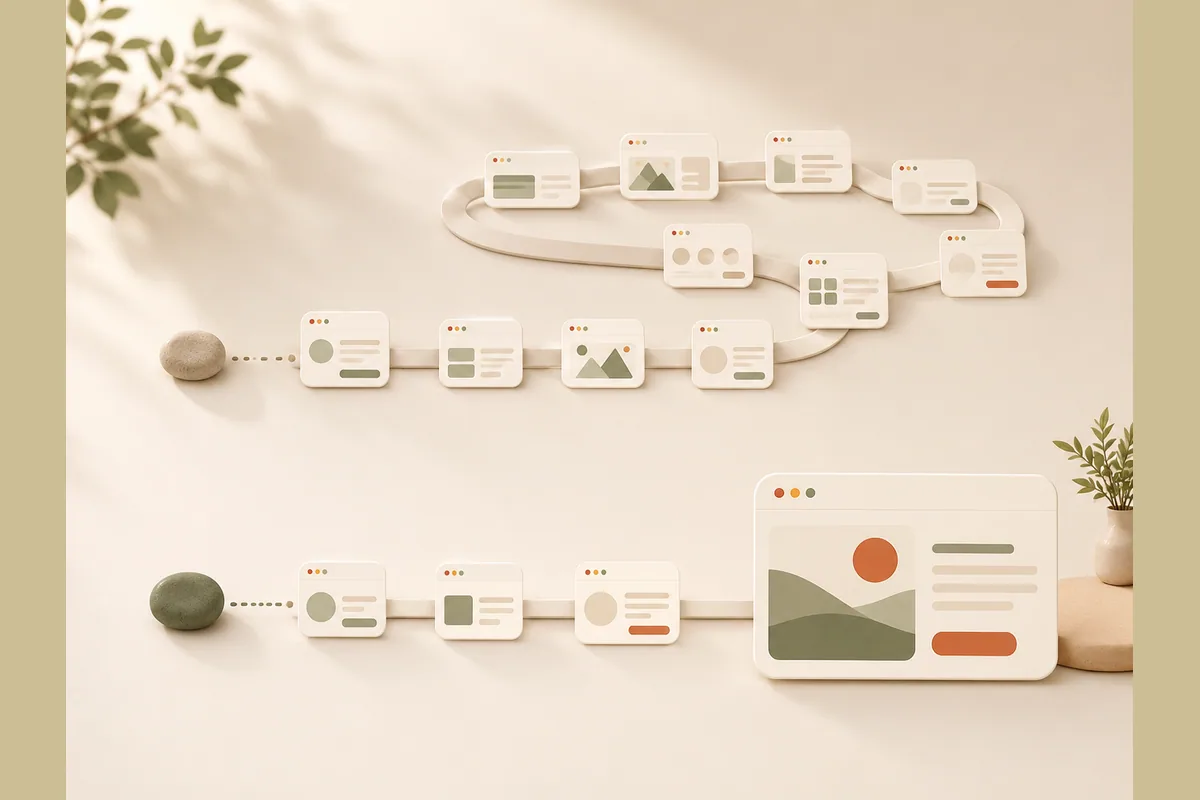
The second limit is workflow. Drag-and-drop was revolutionary in 2014. In 2026 it feels like manual labor. You still pick a template, replace the stock copy with your own, hunt for images, adjust spacing, and check mobile views section by section. None of it is hard, but all of it takes hours. AI-first builders collapse that work into a description of your business and a review pass. We break down that workflow difference in our guide on how AI generates a website.
The third limit is writing. Leadpages gives you a beautiful frame, but the words inside it are your job. For most small business owners, copy is the hardest part, not layout. A template with placeholder text still leaves you staring at a blank headline field.
And then there is price. Leadpages plans sit noticeably above entry-level AI builders, and some of its best features, split testing among them, have historically been tied to the higher tiers. For a lean business, that is real money every month for a tool that covers only part of your web presence.
Note: Price alone should never decide a tool. Price against scope should. Paying more for a narrower product is only rational if that narrow product is the exact bottleneck in your business.
Leadpages vs AI-first builders: the practical comparison
Here is the honest side-by-side for a small business owner deciding in 2026.
| Factor | Leadpages | AI-first builder (e.g. Forgelo) |
|---|---|---|
| Core product | Standalone landing pages | Complete website, pages included |
| Build method | Drag-and-drop from templates | Generated from a one-sentence description |
| First draft time | A few hours of assembly | A few minutes |
| Copywriting | You write it | AI writes it, you refine by prompt |
| Ongoing edits | Manual, block by block | Type the change you want |
| Lead capture | Forms into email tools and CRMs | Lead form straight to your WhatsApp |
| A/B testing | Yes, signature feature | Not the focus |
| SEO | Basic page-level settings | Built-in site-wide SEO |
| Entry price | Higher, tens of dollars monthly | From $9 per month |
Read that table with your own situation in mind. If the rows that matter to you are A/B testing and pop-ups, Leadpages wins them. If the rows that matter are speed, copy, total cost, and WhatsApp leads, the AI column wins. Neither tool is universally better. They are optimized for different users, which is exactly why this decision deserves ten minutes of honest thought instead of a template-count comparison.
The contrarian take: most small businesses do not need a landing page builder
Here is an opinion that goes against a decade of marketing advice: the average small business does not need a dedicated landing page builder at all. Landing page tools were built for a specific playbook, paid ads pointing at single-purpose pages, measured and split-tested at volume. Agencies and funnel marketers live in that playbook. A local service business, a consultant, or an online shop mostly does not.
What that business needs is one good website that explains the offer clearly, loads fast, ranks for its name and a few service keywords, and turns visitors into conversations. That is a different job, and buying a campaign-page tool to do it is like buying a race kart to commute. Fun, specialized, and the wrong vehicle. Our piece on small business website essentials covers what that one good site actually needs, and it is a shorter list than most tool marketing implies.
If you run real ad volume and test aggressively, ignore this section. The playbook is yours and Leadpages serves it well. Everyone else should at least question the premise before paying for it monthly.
Where Forgelo fits as an AI-first alternative
Forgelo approaches the same goal, pages that turn visitors into customers, from the opposite direction. Instead of handing you templates and an editor, it asks for one sentence about your business and generates a complete, publish-ready website in a few minutes. Copy, layout, structure, all drafted for you. From there, editing is conversational: type "make the headline more direct" or "add a pricing section with three plans" and the change happens. No blocks, no spacing fiddles.
Two differences matter most against Leadpages. First, scope: you get a whole site, not a single campaign page, with SEO built in and publishing to a free subdomain or your own custom domain. Second, lead flow: every lead form submission lands directly in your WhatsApp, which fits how a huge share of small businesses around the world actually close sales. If chat is where your deals happen, that single feature outweighs a lot of template polish, and we explain the mechanics in turning visitors into WhatsApp leads.
Pricing is the third difference: plans run $9, $19, and $39 per month, with a custom Agency plan that lets studios ship many client sites from one account, and full white label on the roadmap. For the cost of one traditional landing page tool subscription, you can cover an entire small business web presence, often with room to spare. Compare the tiers on the pricing page and do the math against what you pay now.
Tip: Run a simple test before committing to any builder. Give yourself one hour with each tool and try to get a real page for your actual business live. The tool that gets you to "published and presentable" inside the hour is usually the right one for you.
To be fair in both directions: Forgelo does not offer A/B split testing or a pop-up library, and it does not try to. If those are load-bearing features in your funnel, Leadpages remains the stronger pick.
Verdict: who should pick which in 2026
Choose Leadpages if you are a marketer or agency running paid campaigns, you A/B test with meaningful traffic, your funnel is email-driven, and you already have a main website. Within that lane, it is still one of the most dependable tools available, and its conversion guidance genuinely helps less experienced builders ship better pages.
Choose an AI-first builder if you are a small business owner who needs a complete site live this week, does not want to write copy from scratch, closes sales through conversations rather than email sequences, and cares about total monthly cost. For that profile, the Leadpages landing page builder is a well-made answer to a question you are not asking.
And if you are genuinely torn, sequence it: launch your full site with an AI builder first, since that is the foundation everything else points to, then add a dedicated landing page tool later if your ad spend grows to justify it. Starting with the best AI website builder for your needs costs little, takes an afternoon at most, and leaves every upgrade path open.