If you have searched for website designers for small business, you are probably weighing one real decision: pay a professional to build your site, or generate one yourself with AI and skip the invoice. Both paths can end with a site you are proud of and that brings in customers. The honest answer depends on your budget, how custom your brand needs to be, and whether you want to make changes yourself after launch.
Here is the short version. If you need a distinctive brand, complex features, or you simply want to hand the whole thing off, a designer earns their fee. If you need a clean site live soon, want to control it yourself, and your budget is tight, an AI website builder usually wins. Most small businesses lean toward the second, but not all. Let's break down the real numbers and the real trade-offs.
What website designers for small business actually charge
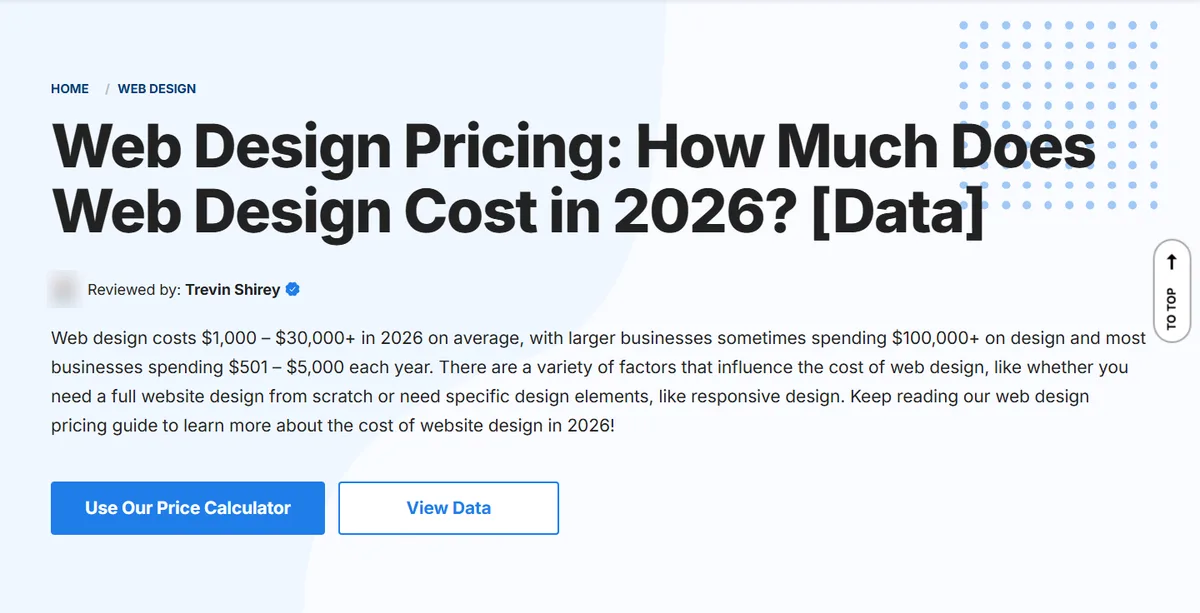
Prices swing a lot because "website designer" covers everyone from a student on a marketplace to a full studio. Rather than guess, here are published benchmarks you can check yourself, all looked up on 23 October 2026.
| Benchmark | Figure | Source |
|---|---|---|
| Typical web design project, 2026 | $1,000 to $30,000+ | WebFX web design pricing survey (250 US marketing professionals) |
| What most businesses spend on web design per year | $501 to $5,000 | WebFX, same survey |
| Most common yearly spend when using a freelancer | $1,001 to $5,000 (37% of respondents) | WebFX, same survey |
| Median wage, web and digital interface designers | $50.00 per hour, $104,000 per year (May 2025) | US Bureau of Labor Statistics, OEWS |
| Median wage, web developers | $44.54 per hour, $92,650 per year (May 2025) | US Bureau of Labor Statistics, OEWS |
| AI website builder (Forgelo) | $9, $19, or $39 per month, plus a free plan | Forgelo pricing |
Two things stand out. First, the ranges are wide because the work is wide: a five-page brochure site and a custom booking platform both get called "a website." Second, the BLS figure is an employee wage, not a client rate. A freelancer or agency has to cover software, taxes, unbilled hours, and profit, so what you are quoted per hour normally sits above that median.
Here is how the main options compare in shape, even before the exact quote arrives.
| Option | How the price usually looks | Time to launch | Best for |
|---|---|---|---|
| Marketplace freelancer | Lowest quotes, often a template with your logo added | One to three weeks | A simple site, tight budget, little strategy |
| Established freelancer | Mid-range project fee, sometimes hourly | Two to five weeks | Custom look plus some guidance |
| Small agency | Highest project fee, often plus a monthly retainer | Four to ten weeks | Branding, strategy, larger builds |
| AI website builder | Flat monthly subscription | Same day | Speed, budget, self-managed edits |
The number on the invoice is only part of the story. A cheap freelancer who hands you a template with your logo dropped in is not the same as a designer who studies your customers and shapes the site around them. Both might quote "a website," but you are buying very different things.
Tip: When you get a quote, ask two questions: what happens when I need a change after launch, and is hosting included? The answers often reveal the true cost more than the build fee does.
What you are really paying for
A good designer sells judgment, not pixels. They ask about your customers, your goals, and your competitors, then make calls you might not think to make. They can spot that your offer is confusing, that your pricing scares people off, or that your best selling point is buried three scrolls down. That kind of read is the real reason the good ones cost more.
You are also paying to hand off the work. For a busy owner, that is worth something. You describe the business, answer a few questions, review a draft or two, and someone else carries it to the finish line. If you never want to open an editor or think about a headline again, a designer buys you that freedom.
The catch is what happens after launch. With most designers, every tweak means an email and a wait, often with a bill attached. Change your hours, add a service, swap a photo, and you are back in the queue. Some work on a monthly retainer, which smooths this out but adds a recurring cost. For a business that updates its site often, that math matters more than the build fee. We walk through the full breakdown in our guide on how much a website costs.

How to hire a website designer without overpaying
If you decide a designer is the right call, a little process up front saves a lot of money later. These steps work whether you hire a freelancer or a small studio.
- Write a one-page brief. List what you sell, who buys it, the three actions you want visitors to take, and two or three sites you like. A clear brief shortens the project and makes quotes comparable.
- Get three quotes on the same brief. Different designers will price different scopes unless you pin the scope down. Same brief, same page count, same features.
- Ask for work similar to yours. A portfolio full of restaurant sites tells you little about a law office. Ask for one or two live sites in a similar category and click through them on your phone.
- Get the after-launch terms in writing. Who hosts the site, who owns the domain, what an edit costs, and how fast changes happen. This is where most surprise bills come from.
- Make sure you own the accounts. The domain, hosting, and analytics should be registered in your name, with the designer added as a user. If the relationship ends, you keep the site.
- Pay in milestones. A deposit, a payment on design approval, and the rest at launch is common and protects both sides.
None of this is about distrust. It is about turning a vague purchase into a clear one, which is better for you and for any designer worth hiring.
When website designers for small business are worth it
To be fair to designers, here is where hiring one is clearly the smart move:
- Your brand has to look like nobody else's, not a polished template.
- You need real functionality: a custom booking flow, a membership area, or a deep integration.
- You are running a larger site with dozens or hundreds of pages and genuine content structure.
- The website is a primary revenue channel and deserves serious investment.
- You truly do not want to be involved and would rather delegate the whole thing.
In those cases, paying for expertise pays off. Forcing an AI builder to do a job it was not built for just means more time spent fighting it than you would ever save.
When an AI website builder does the job
Now the other side. For a lot of small businesses, hiring a website designer solves a problem they do not actually have. If your needs are standard, an AI website builder gets you a clean, professional site without the fee or the wait.
The workflow is simple. You describe your business in a sentence or two, and the site is generated and ready to publish in a few minutes. From there you edit by typing what you want: "make the headline shorter," "add a pricing section with three plans," "move the contact form to the top." No code, no design software, no waiting on someone else's calendar. With Forgelo, that is the whole loop.
The practical wins stack up for a small business:
- A fixed, predictable monthly cost instead of a build fee plus surprises.
- Lead forms that route straight to your WhatsApp (from the Starter plan up), so inquiries land where you already reply. Our guide on turning visitors into WhatsApp leads shows how that changes follow-up.
- SEO basics built in, a free subdomain to launch on, and a custom domain when you are ready.
- Edits included in every plan within a daily AI quota (5 a day on Free, 30 on Starter, 100 on Pro, 300 on Business), so updating the site never triggers another invoice.
For a local plumber, a bakery, a bookkeeper, or a boutique consultancy, a fast site that explains the offer and captures leads is enough to win real work. You can see the deeper comparison in our piece on AI website builders vs hiring a web designer.
The two-year cost picture
Here is the contrarian take: the build fee is the least interesting number in this whole decision. Everyone stares at it, and it hides the part that actually adds up.
Say a designer builds your site for two thousand dollars, which sits inside the WebFX project range above. Feels done. Then over the next two years you add hosting, a maintenance plan, and a handful of paid edits when your hours change or you launch a promotion. Quietly, that site can cost as much again over its life as it did to build. None of it is unfair. It is just real, and most people never budget for it.
An AI builder flips that shape. You pay a subscription, you make your edits yourself, and the cost stays flat. There is no invoice in March because you needed a new page. Here is the same comparison using only published numbers.
| Path | Year one | Year two | Two-year total |
|---|---|---|---|
| Freelancer, staying in WebFX's most common yearly band | $1,001 to $5,000 | $1,001 to $5,000 | $2,002 to $10,000 |
| Forgelo Starter at $9 per month | $108 | $108 | $216 |
| Forgelo Pro at $19 per month | $228 | $228 | $456 |
| Forgelo Business at $39 per month | $468 | $468 | $936 |
The freelancer row is a survey band, not a quote, and your designer may land below or above it. The point is the shape: one path front-loads cost and adds more with every change, the other is flat. For a small business watching cash flow, predictable beats cheap-then-expensive almost every time.
Note: This is not an argument that designers overcharge. It is an argument that you should compare total cost over two years, not the first bill. Sometimes the designer still wins on value. Often, for a standard site, the builder wins on math.
How to actually decide
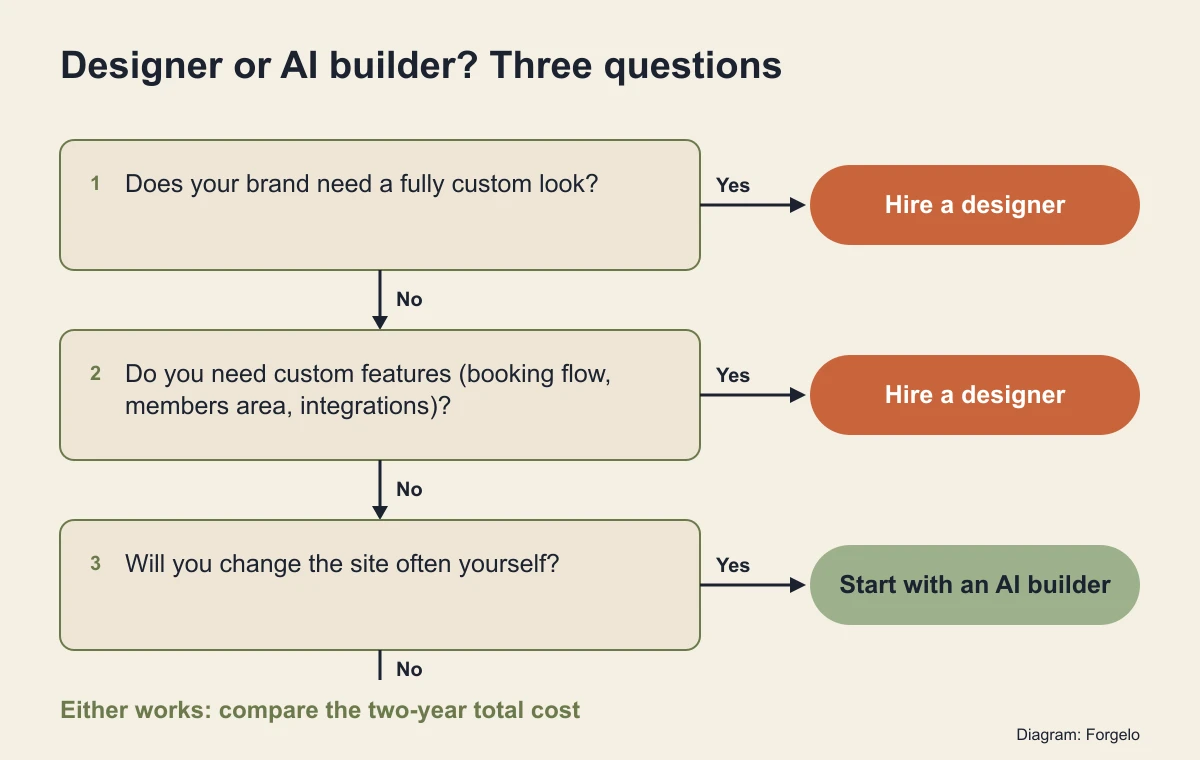
Skip the "which is better" framing. It is the wrong question, because neither is better in the abstract. Ask instead: how custom is my brand, how often will I change the site, and how much do I want to touch it myself?
If your answers are "very custom, rarely change it, never want to touch it," hire a designer and enjoy the hand-off. If your answers are "fairly standard, I'll update it a lot, and I'd rather be in control," an AI builder fits you better and costs less doing it.
One mistake shows up again and again with small business owners: paying for a showpiece design when customers only need three things. They need to know what you sell, trust that you are real, and find a way to contact you. A gift shop, an air conditioning repair service, or a private tutor does not win orders with clever animation. They win because a buyer finds the phone number or WhatsApp button in the first five seconds. If your budget is tight, spend it on clarity and fast follow-up, not on visual complexity nobody reads.
And remember it is not permanent. A common, sensible path is to launch with an AI builder this week, get your first customers, learn what actually works, and only then decide whether a custom designer is worth it. By that point you can brief a designer with real data instead of guesses, and you may find the AI site was already plenty. If you want to see the plans first, our pricing lays out the real numbers.
The bottom line
Website designers for small business are worth every dollar when you need a distinctive brand, complex features, or a genuine hand-off, and you have the budget to match. For everyone else, and that is most small businesses, an AI website builder delivers a clean, professional site faster, cheaper, and under your own control.
The worst move is stalling because you cannot decide. A live, decent site beats a perfect one still stuck in someone's inbox. Start where you are, launch something real, and upgrade to a custom build the day your business actually asks for it.