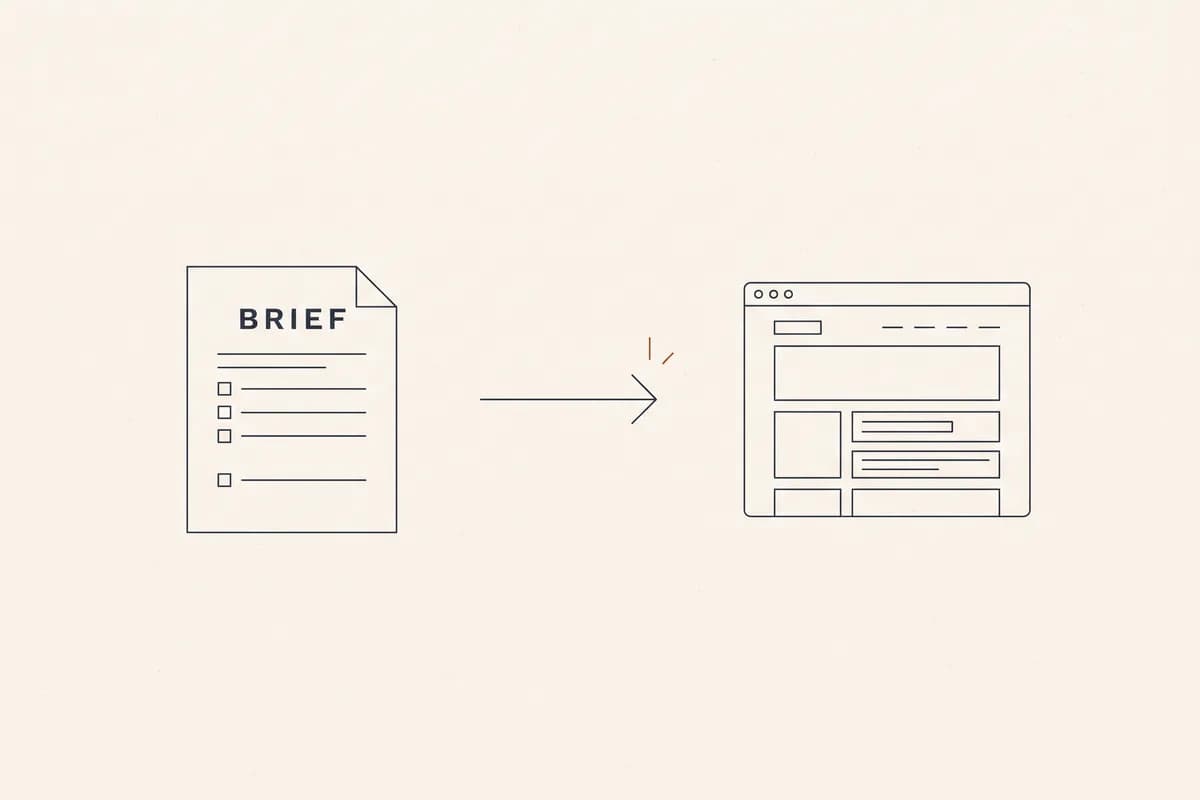
A website brief is the document you hand to whoever builds your site so they know exactly what to make: the goal of the site, the target audience, the pages you need, design references, and the budget. Writing it well is the cheapest way to avoid endless revisions and a project that drags on. But there is good news for small business owners: you can now skip this process entirely, just describe your business in one sentence to an AI website builder, and the site goes live in a few minutes.
This article covers both routes at once. First, how to write a clear website brief if you do plan to hire a service, complete with a framework you can use straight away. Second, when you actually do not need to write a long brief at all. The goal is the same either way: making sure your website turns out the way you want, with the least effort and cost possible.
What a website brief is and why it matters
A website brief is the meeting point between what is in your head and what the builder will actually make. It is not full of technical jargon, it is an explanation of your business, who you are trying to reach, and the kind of website you have in mind. Think of it as a map. Without a map, the builder walks on guesswork, and you only realize the direction is wrong once the site is half done.
From what we often see, the number one cause of a website project dragging on is not the builder's skill, it is a vague brief. A client says "just make it modern and professional", then feels blindsided when the result does not match their picture. The thing is, "modern" in your head and in a designer's head can be worlds apart. A clear brief closes that guessing gap from the start.
The benefits are concrete. A good brief locks the scope, so you have a fair basis to compare quotes from several builders. It also protects you from extra charges, because what must be done is written in black and white. And the effect you feel most is fewer revisions. One hour spent writing a brief often saves weeks of back and forth. If you are still weighing whether to hire a service, the guide to website development services in 2026 covers when a service is truly worth it and when it is not.
The essential components of a website brief
You do not need a thick document. What matters is that every important section is filled in clearly, and every point is marked as required or merely nice to have. Here are the components that should always be present, ordered from the most direction-setting first.
| Brief section | What goes in it | Why it matters |
|---|---|---|
| Goals and objectives | The site's main job: selling, getting leads, or plain credibility | Sets every design and content priority |
| Target audience | Who the ideal visitor is, their needs and their problems | Steers the tone, visuals, and call to action |
| Page list | A rough sitemap: home, services, about, contact, and so on | Sizes the scope and the price |
| Design references | Two or three sites you like, plus brand colors and fonts | Aligns visual taste instead of guessing |
| Content status | Text and photos ready, or need to be created | Often the hidden cause of a stalled project |
| Special features | WhatsApp form, payments, booking, other integrations | Flags work beyond standard pages |
| Budget and deadline | A cost range and when it must launch | Filters for the right builder from the start |
Goals and objectives is the most direction-setting section, yet the one most often skipped. A website chasing leads is clearly different from one that only needs to look credible. Say what you consider success, for example "visitors contact us on WhatsApp", so the builder knows where to point every button.
The section that trips people up the most is actually content status. Many assume the builder will prepare all the text and photos, when often that is not the case. In our view, the unclear ownership of content is the hidden reason website projects stall for weeks. Spell it out in the brief: what you provide, and what you ask the builder to create.
A ready-to-use brief framework
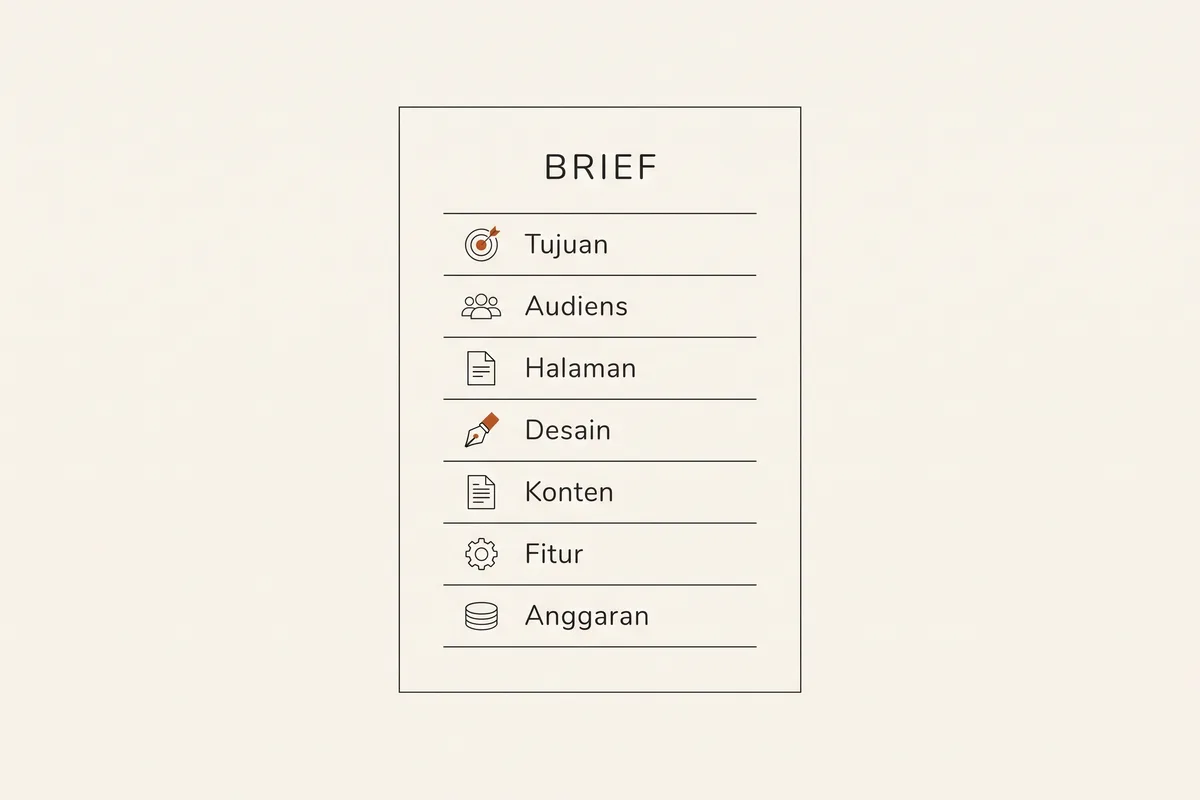
To keep it concrete, here is a compact framework you can copy and fill in. One to two pages is plenty. Summary at the top, details below it.
- About the business: name, type of business, location, and what sets you apart, in one paragraph.
- Site goal: one sentence of success, for example "get 20 prospect enquiries per month through the form".
- Target audience: who they are and what they are looking for when they land on your site.
- Pages needed: a bullet list, marking which are required and which are optional.
- Design references: two or three links to sites you like, with a short note on why.
- Brand: primary colors, fonts if any, and the logo (attach the file).
- Content: what is ready, and what needs to be created for you.
- Special features: be specific, for example "a form that sends a notification to WhatsApp".
- Budget and deadline: a number range and a target launch date.
- Contact and approval: who signs off on revisions, and how feedback is given.
A small trick that is rarely used: include one paragraph titled "what to avoid". Name the things you do not want, for example a layout that is too busy or intrusive pop-ups. Saying what you dislike often helps the builder more than a long list of things you like. For a sense of cost by type of builder before you lock a budget, see the breakdown of website development pricing.
Common mistakes when writing a brief
A bad brief is not a short brief, it is an ambiguous one. A few patterns repeat, and all of them are avoidable once you know the signs.
The first is using adjectives without examples. "Modern", "elegant", "professional" all sound clear in your head but can be read in dozens of ways. Always attach a visual reference to every adjective. One link to a site is worth more than ten adjectives.
The second is putting every request at the same priority. If every feature is marked required, the builder does not know what can be compromised when budget or time runs short. Draw a firm line between required and desired. This protects you too: a feature that sounds impressive but customers never use belongs in the "later" pile.
The third, and honestly this is a mistake we made ourselves early on, is forgetting to define when the project counts as finished. Without clear completion criteria, revisions can run without end, and the relationship with the builder ends on a sour note. Write into the brief what "done" looks like. For a fuller list of traps when dealing with a service, read the common mistakes when using a website service.
Or skip the brief: describe your business in one sentence to AI
Now the part rarely covered in other articles. For most small businesses, the entire brief-writing process can actually be skipped. Not by simplifying the brief, but by changing how you express what you want.
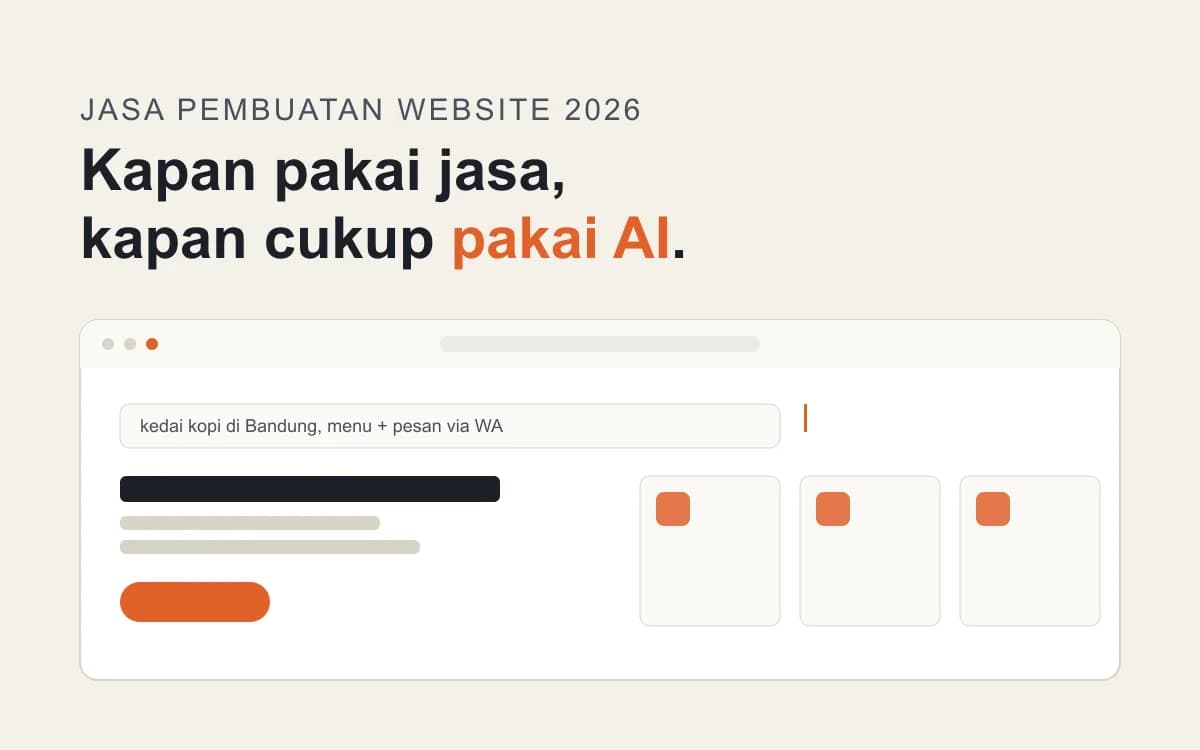
With an AI website builder, you do not draft a document and then wait. You just describe your business in one sentence, and a complete website is built in a few minutes. Forgelo is designed for people who are not developers, so the flow is deliberately as simple as possible. You write something like "a coffee shop in Bandung with a menu and ordering via WhatsApp", and the site is forged after a short processing step, complete with a hero, a list of services, social proof, and a call to action.
What makes it different from filling in a rigid form is that your brief is alive and can keep changing. To adjust something, you click the part you want to change and type the instruction, for example "make the headline punchier" or "add a price table". Forgelo rebuilds only that part, leaving the rest intact. So you do not lay out every wish up front and then pray it fits. You express it while watching, one instruction at a time. You can see the full flow on the how Forgelo works page.
The biggest advantage is not just the absence of a document, it is speed. A website that is live today can start taking questions from potential customers, while a brief-based project is still waiting on a first draft. If launch speed is what you are after, compare it further with fast website building.
When a brief is still worth it, and when to skip it
This does not mean a brief can always be dropped. There are cases where writing a thorough brief is the right call, and forcing the fast route only causes trouble. Lean toward a full brief and a professional service if your need fits one of these.
- Custom logic and integration: a site connected to internal systems, an ERP, or a complicated booking flow. This is a developer's job, and a detailed technical brief becomes essential.
- Deep art direction: a brand with a very specific visual identity, custom illustration, or an unusual interactive experience.
- Scale and contractual accountability: a company that needs an SLA, a security audit, or long-term support under a formal agreement.
On the other hand, you can almost certainly skip the long brief if what you need is a company profile, a landing page, a small shop, or a standard small business site. For needs like these, most of a traditional brief just documents things you could do yourself in minutes. The trick is an honest assessment: do you really need all that complexity, or is a credible site that goes online quickly actually enough? If you are torn between the budget route and the service route, the comparison of a cheap service versus building it yourself with AI can help you decide.
How to start: write a brief or try the fast route
If your need is complex and you will be hiring a service, start from the brief framework above. Fill in the goals and target audience first, because those two steer the rest. Mark required versus desired, attach two or three visual references, and make clear who prepares the content. With a brief like that, the quotes you receive will be far more apples to apples, and your negotiating position is much stronger.
If your need is standard, the fastest way to decide is to try it yourself before writing anything. You can write one sentence about your business and watch a finished website appear in a few minutes, free, with no credit card required. If it works, just connect your own domain with a small subscription. If it turns out your needs really are complex, that experiment still gives you a concrete picture before you hire a service, and the brief you write afterward will be far sharper.
Try Forgelo for free and turn one sentence into a ready-to-publish website. From prompt to website in a few minutes, then just chat with it to refine part by part.