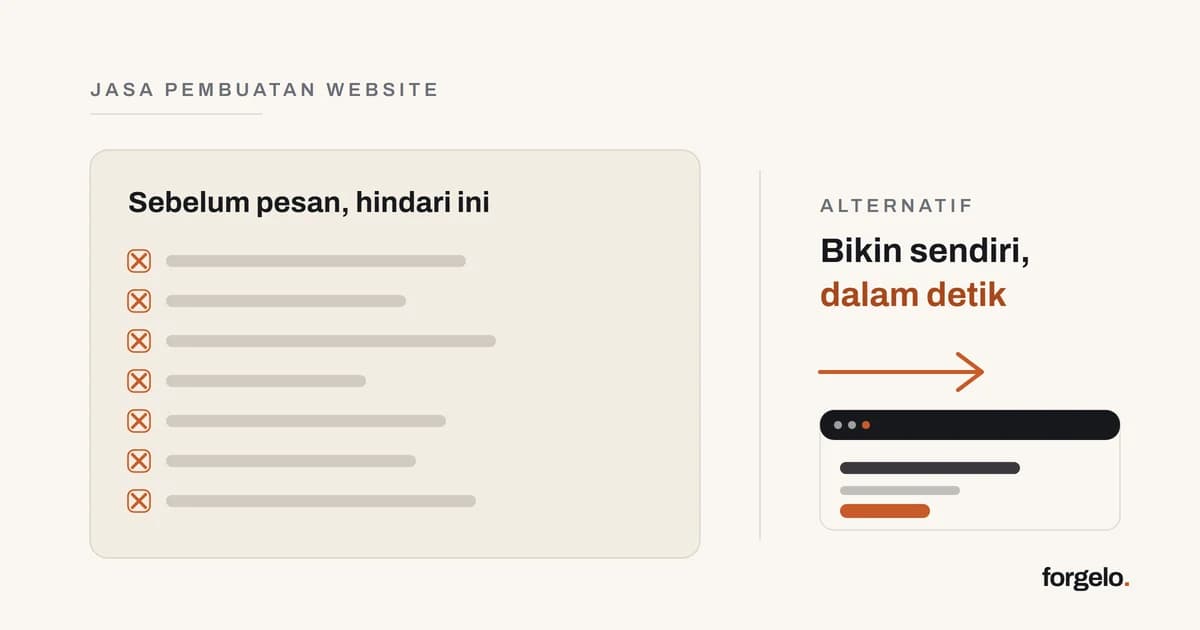
The most common website development mistakes are not technical, they are about agreements and preparation: unclear scope, getting tempted by the cheapest price, and forgetting to confirm who owns the domain and hosting. The result is projects that run late, costs that balloon, and an end product that does not match expectations. The good news is that nearly all of these mistakes can be avoided if you know what to ask from the very start.
This article rounds up the seven mistakes we see most often when people order website development services, complete with how to avoid each one. At the end, we also cover an alternative that often gets overlooked: building your own website with AI in a few minutes, which removes a lot of these failure points at once. Think of it as a checklist before you send your first payment.
Mistake 1: Not agreeing on scope and deliverables in writing
This is the root of most of the other problems. Many people start with a vague verbal agreement, like "just build me a nice website," without defining the number of pages, features, rounds of revisions, and exactly what they receive at the end. When expectations are not written down, the two sides interpret "done" differently, and that is where conflict starts.
From what we often see, healthy projects always begin with a simple scope document: a list of pages, features per page, the number of revisions included, deadlines, and a list of final deliverables (files, access, documentation). Without this, every small mid-project request can be argued as "out of scope," and you lose your bargaining position. Before you pay, get everything in black and white, even if it is just a written message that you and the provider agree on together.
Mistake 2: Getting tempted by the cheapest price without checking quality
A low price is tempting, but with website development services, the cheapest is often the most expensive in the long run. An offer that is too low usually covers its costs by cutting something: a one-size-fits-all template with no customization, no basic optimization, or heavily limited revisions. What looks economical at first can turn into a string of added costs the moment you ask for changes.
Instead of fixating on the smallest number, look at the overall value. What is included in that price? Is there a revision guarantee, post-launch support, and a verifiable track record? Ask to see real portfolio work and, if you can, contact one or two of their past clients. To understand what reasonable pricing looks like, it is worth first reading the breakdown of website development service prices so you can tell a sensible offer from one that is too good to be true. A serious provider is usually transparent about what you do and do not get, rather than just naming the lowest figure.
Mistake 3: Not confirming ownership of the domain, hosting, and access
This is the mistake whose impact only surfaces months later, and unfortunately it is the most often ignored. For convenience, many people let the service provider register the domain and hosting under the provider's own name. As long as the relationship is good, everything runs smoothly. The problem appears when you want to switch providers, and you realize you do not hold access to assets that belong to your own business.
Confirm three things from the start: the domain is registered under your name and email, you have full login access to the hosting, and you receive admin access to the website dashboard. This is not about distrust, it is about independence. A website is a business asset, and a business asset should sit in the hands of the business owner. If a provider is reluctant to hand over this ownership, treat it as a red flag. What people rarely realize is that this kind of dependence is one of the main reasons they eventually move to a platform they control themselves.
Mistake 4: Ignoring SEO basics and the mobile experience
A beautiful website that cannot be found on Google is the same as a brochure left in a drawer. Many projects focus on looks and forget the foundations that make a website useful: a clean heading structure, correct page titles and descriptions, speed, and a comfortable experience on phones. Yet most small-business visitors in Indonesia come from a phone, and Google evaluates the mobile version first.
When ordering a service, ask specifically whether SEO basics and mobile are included, not an add-on. Have them explain how they handle page titles, URL structure, and speed. If the answer is vague, this part is most likely done half-heartedly. For a picture of what these important foundations include, the website SEO basics guide can be a starting point. Getting the foundation right from the start is far cheaper than fixing it after the site is live.
Mistake 5: Not preparing materials and a brief from the start
The number-one cause of delayed projects is not the builder's technical ability, it is materials that are not ready. A logo still being designed, copy not yet written, photos not yet taken, all of it holds up the whole process. A builder cannot put together a services page if the list of services is not clear, and every day spent waiting is a day the project does not move.
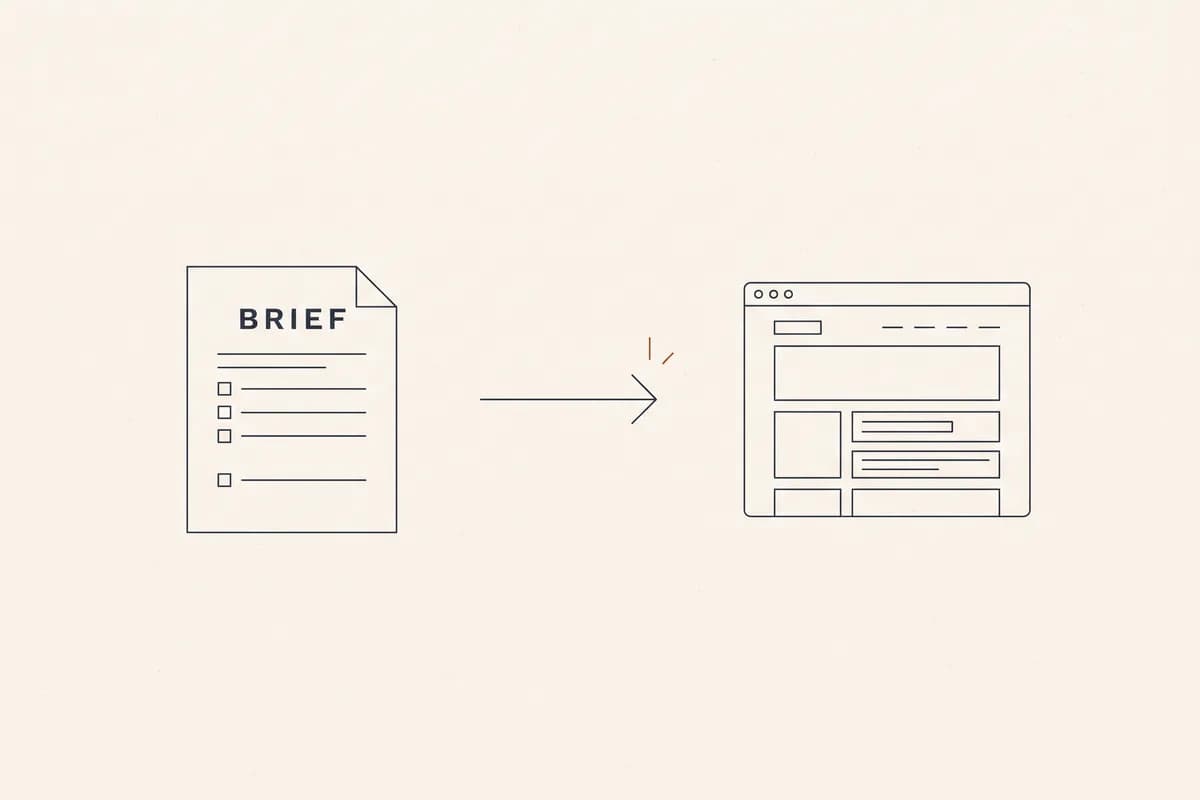
Before you order, prepare a core materials pack: a few sentences describing your business, a list of services or products, contact details, a logo, and a few photos. Also decide on the website's goal and one or two sites you like. A clear brief not only speeds up the project, it also produces a website that fits your wishes better, because the builder does not have to guess. Interestingly, once you have a brief this clear, you are actually ready to try building it yourself first, and that brings us to the next point about timing.
Mistake 6: Forgetting to think about who manages the website after it is done
A website is not a one-and-done project, it is something living. Prices change, services get added, promotions come and go. Many people only realize after the site goes live that every small change, swapping a phone number, adding a page, editing a price, has to go through the service provider, often with its own cost and waiting time.
Before you decide, ask how updates work after the project is finished. Can you change things yourself, or does it always have to go through them? If every small change means waiting and paying again, the real cost is far higher than the upfront price. This is one reason many business owners now choose a platform that lets them change their website's content anytime, independently, without depending on someone else's schedule. The question "who manages this next month" is just as important as "who builds this now."
Mistake 7: Waiting too long for "perfect" before going live
The last mistake often comes from good intentions. In pursuit of a perfect result, the project gets stuck in an endless revision loop, and the website that should already be working keeps getting delayed. Yet a website that is live, even if not perfect, is already getting visits, getting indexed by Google, and receiving inquiries, while one that is still being polished produces nothing.
In our experience, momentum is worth more than perfection at the start. It is better to go live sooner with a version that is good enough, then refine it as you go based on real feedback from visitors. This approach is only possible if you can change the website easily, and this is where the difference between the traditional service route and a more modern one feels sharpest. If you are curious how fast a website can really be made, see our discussion of fast website-building services.
The alternative: skip many of these mistakes by building it yourself with AI
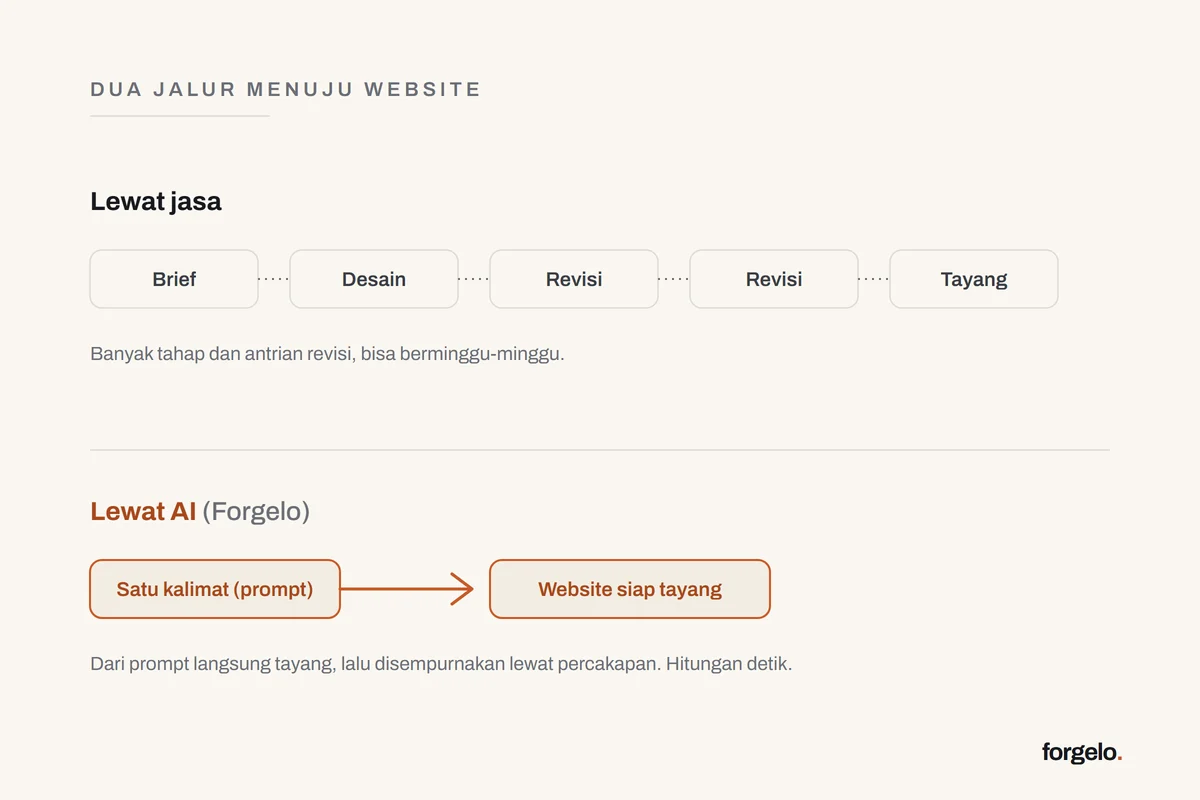
If you look closely, most of the mistakes above stem from the same thing: you depend on someone else to build and change your website. An AI website builder cuts that dependence. Instead of writing a brief and then waiting, you simply describe your business in one sentence, and a complete website is built in a few minutes. For a side-by-side look at when each route wins, read the web design service vs AI website builder breakdown.
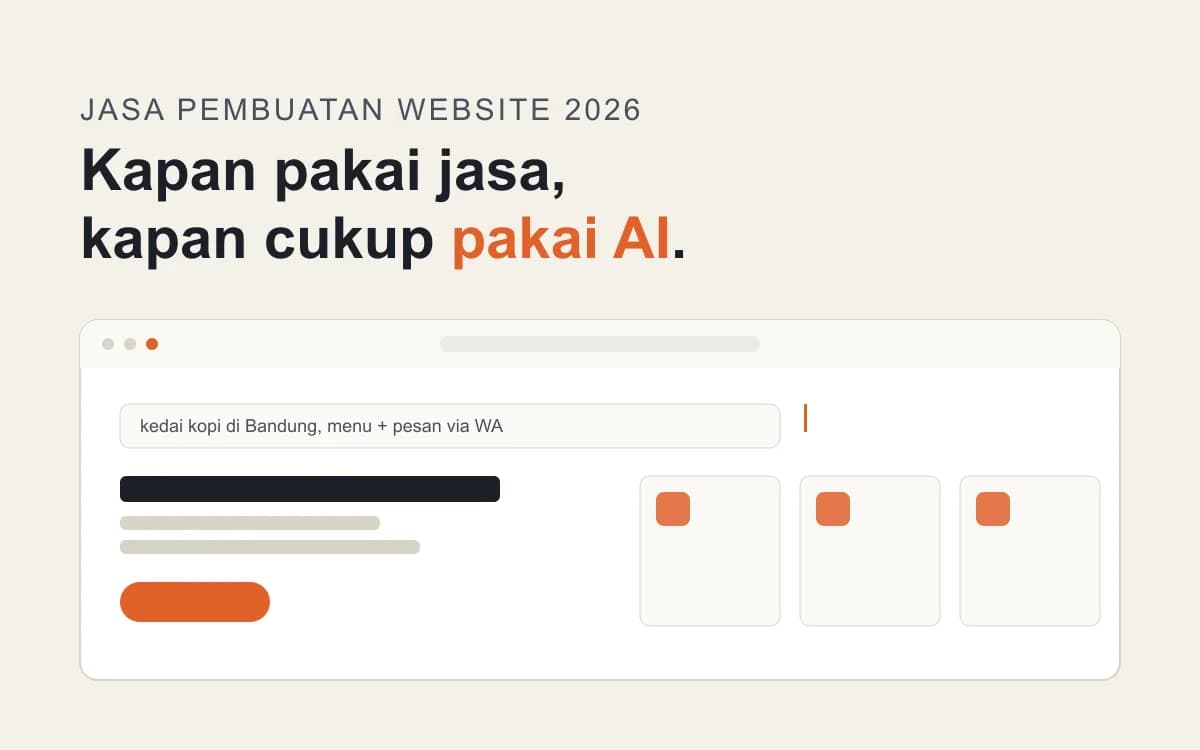
Forgelo is designed for people who are not developers, so the flow is deliberately simple. You write something like "a coffee shop in Bandung with a menu and ordering via WhatsApp," and the site is forged in a few minutes. To change something, you do not touch code and you do not drag blocks around a canvas. You click the part you want to change and type the command, for example make the headline punchier or add a pricing table, and Forgelo rebuilds only that section. Notice how this answers the mistakes above: scope is in your hands, there are no hidden costs, the domain and content stay yours, the SEO foundation is automatic, and updates can happen anytime without waiting on anyone.
| Mistake when hiring a service | How an AI website builder solves it |
|---|---|
| Vague scope, easy to slip | You see the result immediately and change it yourself as needed |
| Hidden costs | One clear subscription, no separate revision bills |
| Assets held by someone else | The domain and website content stay yours |
| SEO and mobile overlooked | Clean structure, mobile friendly, and an automatic SEO foundation |
| Hard to update once done | Change any section just by typing, anytime |
Of course, this does not mean website development services are useless. For genuinely complex, custom, or large-scale projects, professional services are still the right choice. If you want to know when to still hire a pro and when AI is enough, the website development services 2026 guide covers it in full. To see the flow from prompt to live, there is also the how Forgelo works page.
Conclusion
The seven mistakes above share one common thread: a lack of clarity at the start and dependence on someone else. Agree on a written scope, do not get tempted by the cheapest price, confirm asset ownership, do not ignore SEO and mobile, prepare your materials from the start, think about who manages the website later, and do not delay going live in pursuit of perfection. This simple checklist alone is enough to avoid most regrets.
But if you want to skip almost all of those failure points at once, the fastest way is to prove it yourself. You can write one sentence about your business and watch a finished website appear in a few minutes, free, no credit card. If it fits, just connect your own domain. If your needs turn out to be genuinely complex, you still come out ahead because you have a clear picture before hiring anyone.
Try Forgelo for free and turn one sentence into a ready-to-publish website today. From prompt to website in a few minutes, and then you just talk to it to make it perfect.