Website building services that are genuinely fast can finish a simple company profile in a matter of days, but the average project still takes several weeks because of revisions and job queues. Ideally, for a standard small-business need, a website should be able to go online much faster than that. With an AI website builder, a complete website can be generated from a single sentence in a few minutes, and then you refine it yourself.
This article answers the questions that come up most often before you order: how long a website should ideally take, what drags the work out, and how to get a fast website without sacrificing quality. Every estimate here is a rough range for the Indonesian market, because build time depends heavily on complexity, how clean the brief is, and how fast revisions move.
How long should a website ideally take?
The honest answer: it depends on the path you choose. For standard small-business needs, here is a rough picture of the time from start to live.
| Path | Estimated time to go live | Notes |
|---|---|---|
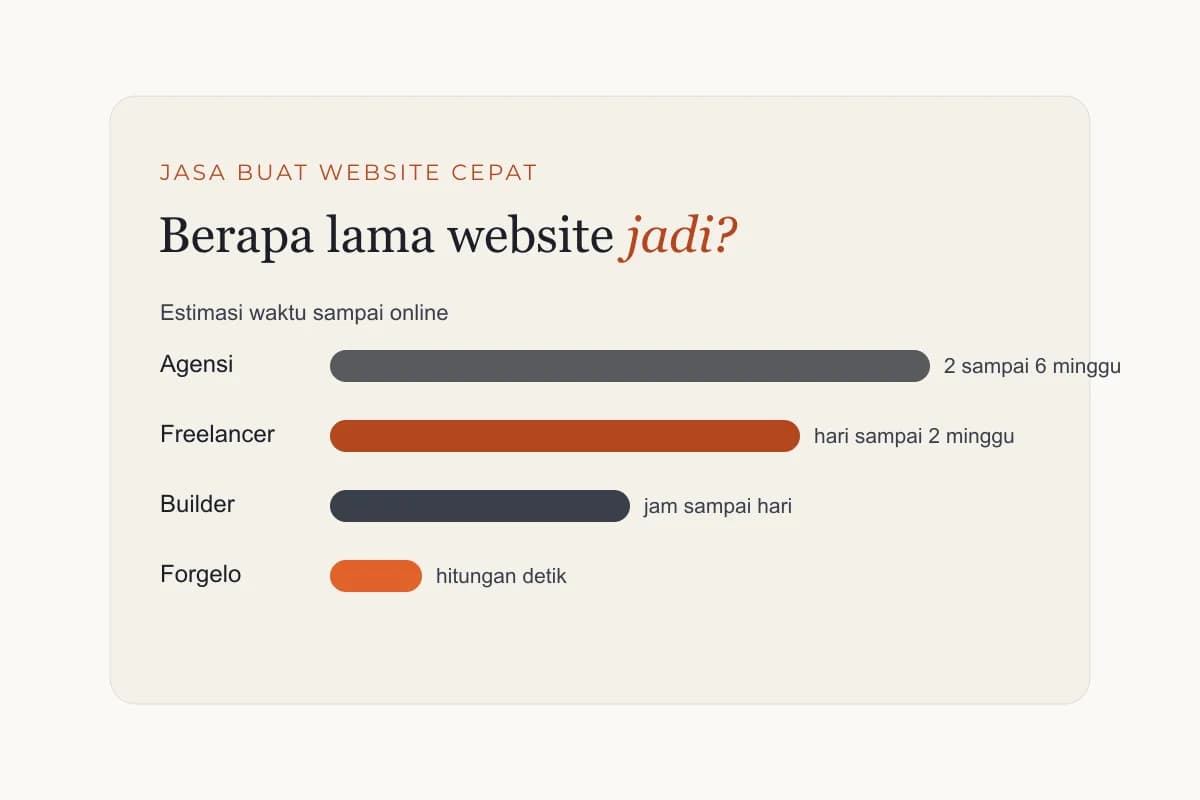
| Freelancer | A few days to 2 weeks | Depends on queue and revision speed |
| Software house / agency | 2 to 6 weeks | Includes brief, design, revisions, testing |
| Drag-and-drop builder | A few hours to several days | Fast, but you assemble it yourself |
| AI website builder (Forgelo) | A few minutes | Initial generation in a few minutes, refine through prompts |
Interestingly, "ideal" and "common" often differ wildly. Technically, assembling a company profile page can be done in hours. But in practice, most of the time goes not into building but into waiting: waiting for materials, waiting for approval, waiting for your turn in the revision queue. From what we often see, it is this waiting gap that turns a "fast" project into a multi-week one. So when you evaluate a website building service, do not only ask how long they take to build, but how long the total time is from when you order to when the site is genuinely online. Those two numbers are often very different, and the second one matters more to you.
Factors that determine website build time
Before picking a website building service, it helps to understand what actually eats up time. That way you can judge a promise of "fast" realistically.
- Scope and number of pages: a single landing page is clearly faster than a ten-page site with lots of features.
- Material readiness: a logo, photos, and text that are not ready will hold up the entire process, no matter how good the builder is.
- Revision rounds: every revision is one cycle of send, wait, reply. Just three or four rounds can add weeks.
- Builder's queue: a freelancer or agency works with many clients. Your project enters a queue rather than starting immediately.
- Decision making: the more people who must approve, the slower decisions get made.
As an illustration, two projects with the same number of pages can finish with a difference of up to twice the time, simply because one has its materials ready and few revisions, while the other has materials trickling in and revisions stacking up. So the question of "how long" really cannot be answered without knowing how prepared you are.
In our view, the human factors (communication, revisions, queues) almost always matter more than the technical ones. This is exactly the gap that the AI approach closes, because you no longer depend on anyone else's schedule.
Why "fast website building services" often run late
Nearly every provider advertises the word "fast". But fast in the proposal and fast in reality are often different. The cause is usually not laziness, it is the structure of the work itself.
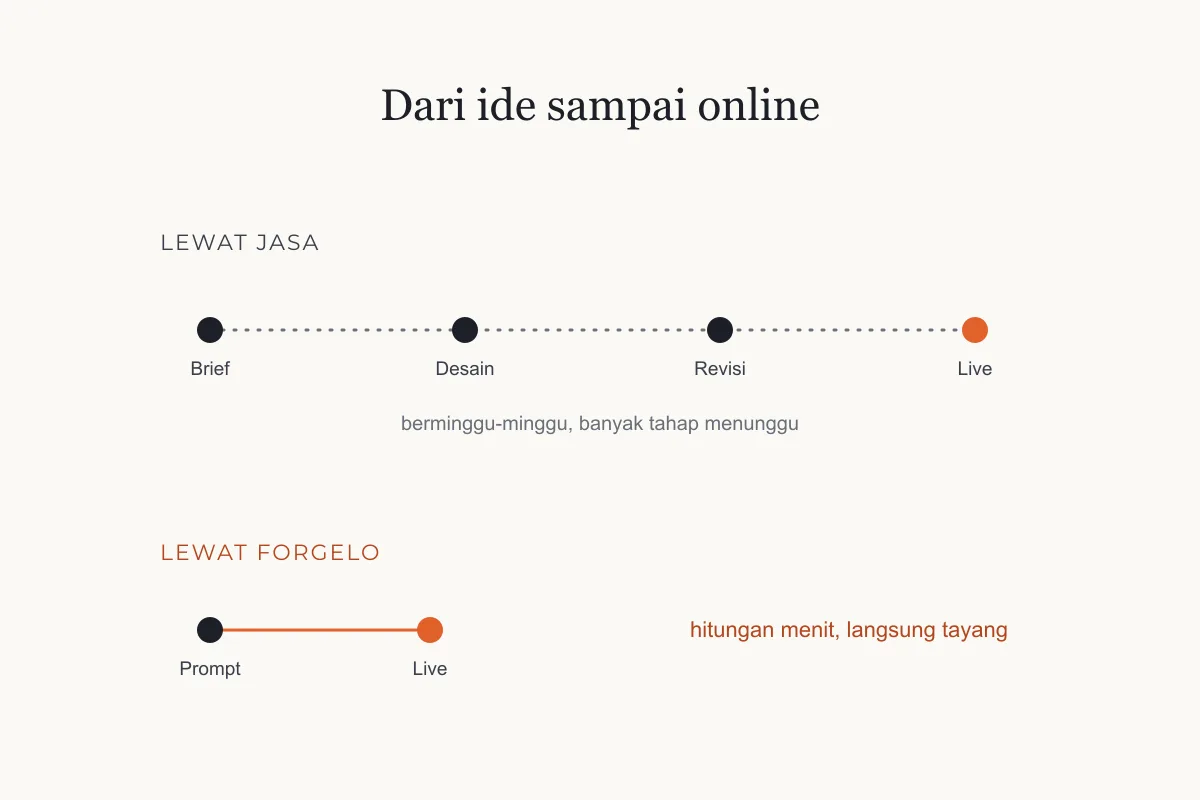
When you use a service, your speed is limited by other people's speed. The builder has to understand the brief, design, write content, then send a draft. You reply with revisions, and the cycle repeats. Each round adds days, sometimes weeks, especially when one side is busy. What is rarely admitted is that this revision stage is precisely where projects most often blow past the original estimate.
A common scenario: you order a website building service with a one-week promise. Day one goes to the brief, then the first draft only arrives on day four. You ask for three small changes, and each one takes one to two days because the builder is also handling other clients. Before you know it, "one week" turns into three weeks. Not because the work is heavy, but because the back-and-forth rhythm itself is slow.
There are also services that really are super fast, one to three days. But that is usually achieved with ready-made templates and minimal customization. There is nothing wrong with that, as long as you understand that this kind of "fast" trades flexibility for speed. If you want to be fast and still able to change anything yourself, the path is different. For a sense of the cost of each path, see also our breakdown of website building prices.
The fastest alternative: from prompt to website in a few minutes
This is where an AI website builder changes the entire time equation. Instead of writing a brief and then waiting, you simply describe your business in one sentence, and a complete website is generated in a few minutes. Not a thin landing page, but a full site with a hero, services, social proof, and a call to action.
Forgelo is designed for people who are not developers, so the flow is intentionally as simple as possible. You write something like "a coffee shop in Bandung with a menu and ordering via WhatsApp", and the site is forged on the spot. What makes it different is that you do not touch code and you do not drag blocks around a canvas. To change something, you click the part you want to change and type the command, for example make the heading bolder or add a pricing table. Forgelo rebuilds only that part, and the rest stays intact.
The speed does not come from cutting quality. Every site already comes with a clean foundation: correct heading structure, mobile friendliness, and SEO basics. What gets removed is the waiting time and the revision queue, not the foundation. If you are curious about the engine behind it, read how AI generates a website, or see how Forgelo works step by step.
Time comparison: service vs DIY builder vs AI
To keep this concrete, let us line up the three paths in terms of time and control. The exact figures are always relative, but the comparison pattern is consistent.
| Aspect | Service (freelancer/agency) | Drag-and-drop builder | AI website builder (Forgelo) |
|---|---|---|---|
| Initial generation time | A few days (after the brief) | You assemble it yourself | Seconds |
| Time to go live | A few days to weeks | Hours to several days | Same day |
| How to make changes | Send revisions, wait in queue | Drag and arrange yourself | Type a command, that part is rebuilt |
| Dependent on other people | Yes | No | No |
| Skill required | No, but dependent on others | Need to learn the editor | Just be able to describe your business |
Notice the "dependent on other people" row. This is the biggest differentiator when it comes to speed. As long as you are waiting on someone else, time is not in your hands. Once you can build and change things yourself, speed becomes entirely under your control. If you want to know when it still makes sense to hire a service, the website building services 2026 guide covers it in full.
Does fast mean cheap and shoddy?
This is a reasonable concern, and the answer needs nuance. Speed only becomes a problem when it is achieved by sacrificing things that matter: clean structure, correct mobile display, or SEO basics. If all three are still in place, fast is an advantage, not a weakness.
But honestly, here is what rarely gets discussed: build time is not a guarantee of quality. Many projects that drag on for months still produce mediocre websites, because the time went into coordination rather than into making the result better. Conversely, a website built in minutes can feel mature if its foundation is correct and its content is clear. What determines final quality is the clarity of the brief and how well you refine it, not how long it took to build.
In our experience, clients who delay publishing in pursuit of the word "perfect" actually lose momentum. A website that goes live sooner starts getting visited, indexed by Google, and receiving inquiries, while the one still being polished produces nothing yet.
So the question is not "fast or high quality", it is "does this speed sacrifice something important". If it does not, there is no reason to wait longer just to feel that the process was "serious".
How to get a fast website without sacrificing quality
The fastest strategy is not simply picking the provider who promises the soonest day, it is picking the path that removes the causes of delay. A few practical steps:
- Prepare your core materials first (name, services, contact, a few sentences about the business) so nothing holds up the process.
- For standard needs, use an AI website builder so you do not enter a queue and do not wait on other people's revisions.
- Start from an industry template as a starting point, then adjust through commands rather than from scratch.
- Reserve professional services only for the parts that are genuinely complex and custom.
- Publish the first version sooner, then refine as you go. A website that is already online works better than a draft that is perfect but not yet live.
The bottom line: a website building service still makes sense for projects that are genuinely complicated or highly custom. But for the majority of small-business needs, the fastest and least hassle path is to build it yourself with AI, then refine it gradually after it goes live.
The quickest way to prove this is to try it yourself. You can write one sentence about your business and watch a finished website appear in a few minutes, free, no credit card needed. If it fits, just connect your own domain. And if your needs really are complex, you still come out ahead because you have a clear picture before hiring a service.
Try Forgelo for free and turn one sentence into a website that is ready to publish today. From prompt to website in a few minutes, then you just chat with it to refine it. No queues, no waiting your turn behind other people.