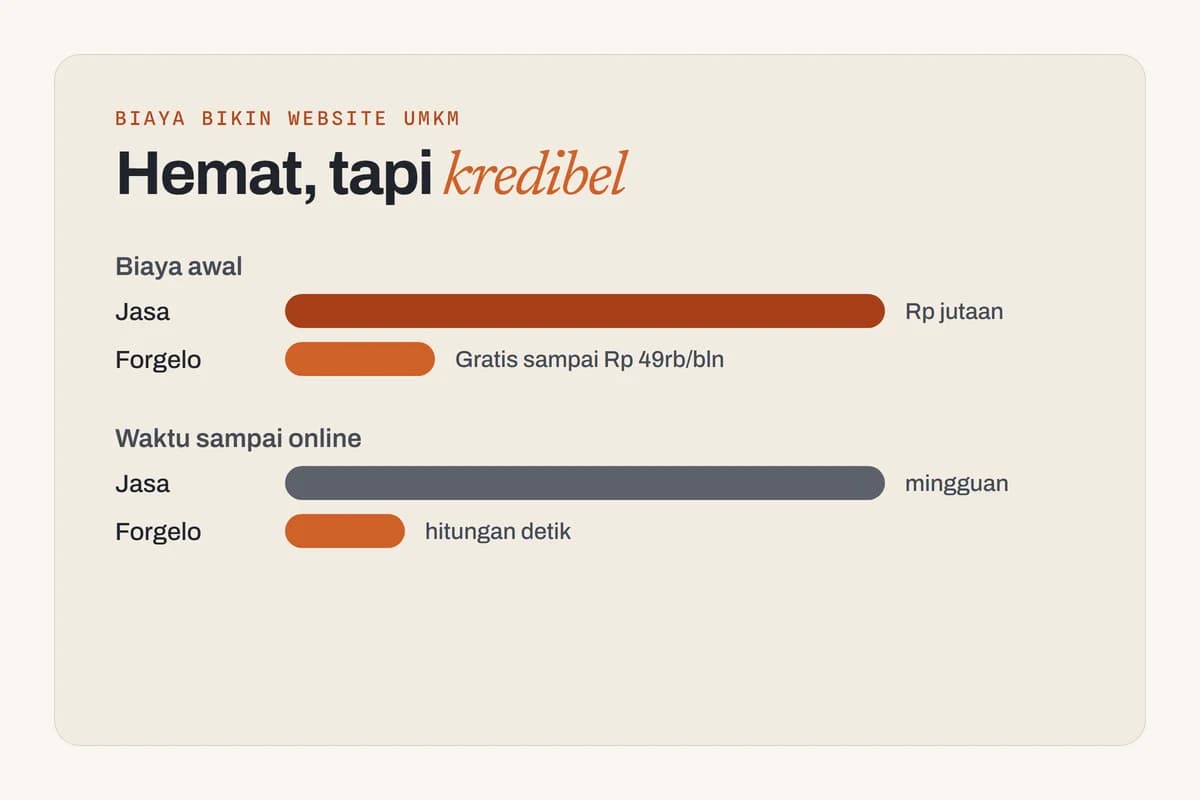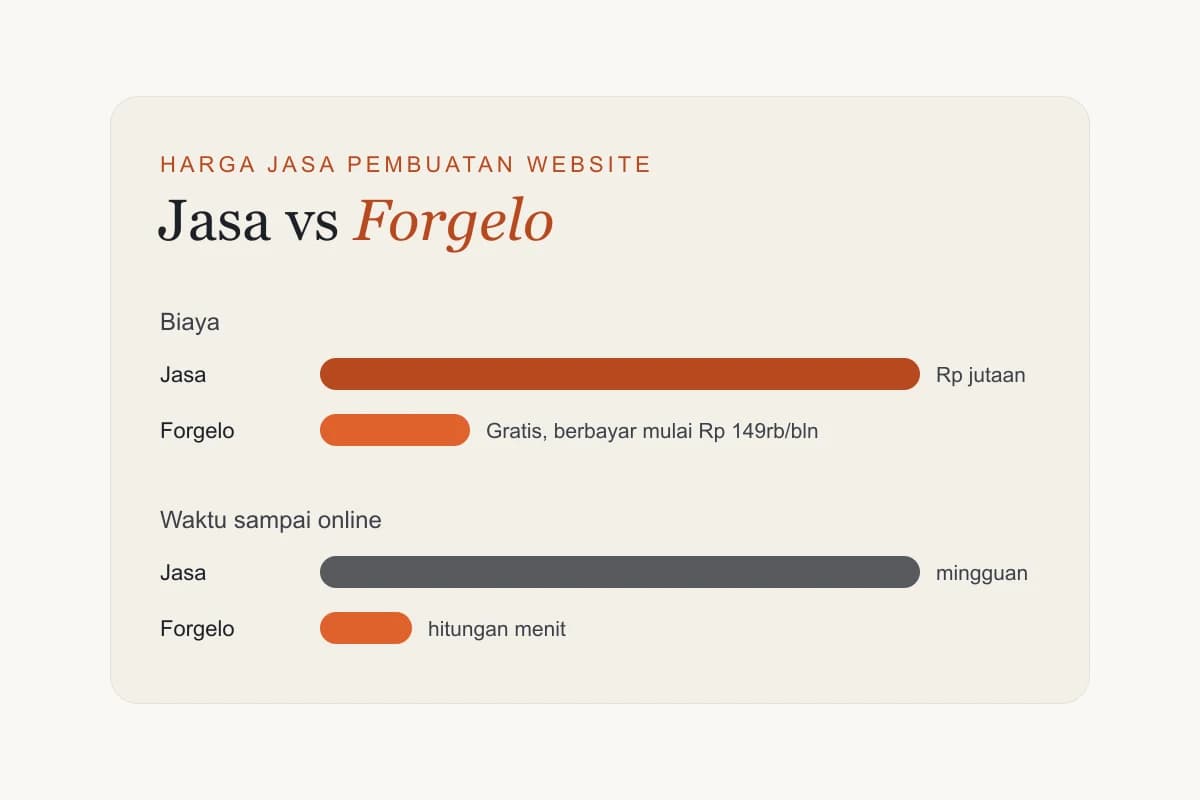
Website development pricing in Indonesia in 2026 ranges from a small fee for freelancers up to tens of thousands of dollars for agencies, depending on the number of pages and the level of complexity. But there is good news for small business owners: you can now have a finished website without paying for a service at all, simply by describing your business in one sentence to an AI website builder, and the site goes live in a few minutes.
This article breaks down website development pricing honestly: the rough range for each type of builder, which cost components often stay invisible in the proposal, why the price can be that high, and when the cheaper AI alternative truly makes sense. Every figure here is a rough range for the Indonesian market, not a firm quote, because prices depend heavily on the city, the builder's experience, and how complex the project is.
How much does website development cost in 2026
Website development pricing moves across a very wide range, so a single number would mislead. It is more useful to look at it by type of builder. Here is the rough picture.
| Type of builder | Price range | Best suited for |
|---|---|---|
| Freelancer | A small fee up to a few hundred dollars (one time) | Simple company profile, tight budget |
| Software house / agency | A few hundred up to several thousand dollars | Multi-page, custom design, tidy process |
| Large custom project | Thousands to tens of thousands of dollars | Web app, system integration, complex e-commerce |
A freelancer is the cheapest way in. For a standard company profile, you can get a price from a small fee up to a few hundred dollars. The trade-off is that speed and revision availability depend heavily on one person's schedule. From what we often see, the revision stage is exactly where cheap freelance projects tend to drag.
Agencies and software houses are the next tier up, starting from a few hundred up to several thousand dollars. You pay more for a team, a tidier process, and clearer accountability. Meanwhile, a large custom project like a web app or an online store with complicated logic already moves into software development territory, so it makes sense that the number reaches tens of thousands of dollars. For a deeper cost comparison between builders, freelancers, and agencies, take a look at the breakdown of website costs.
Cost components that are often invisible
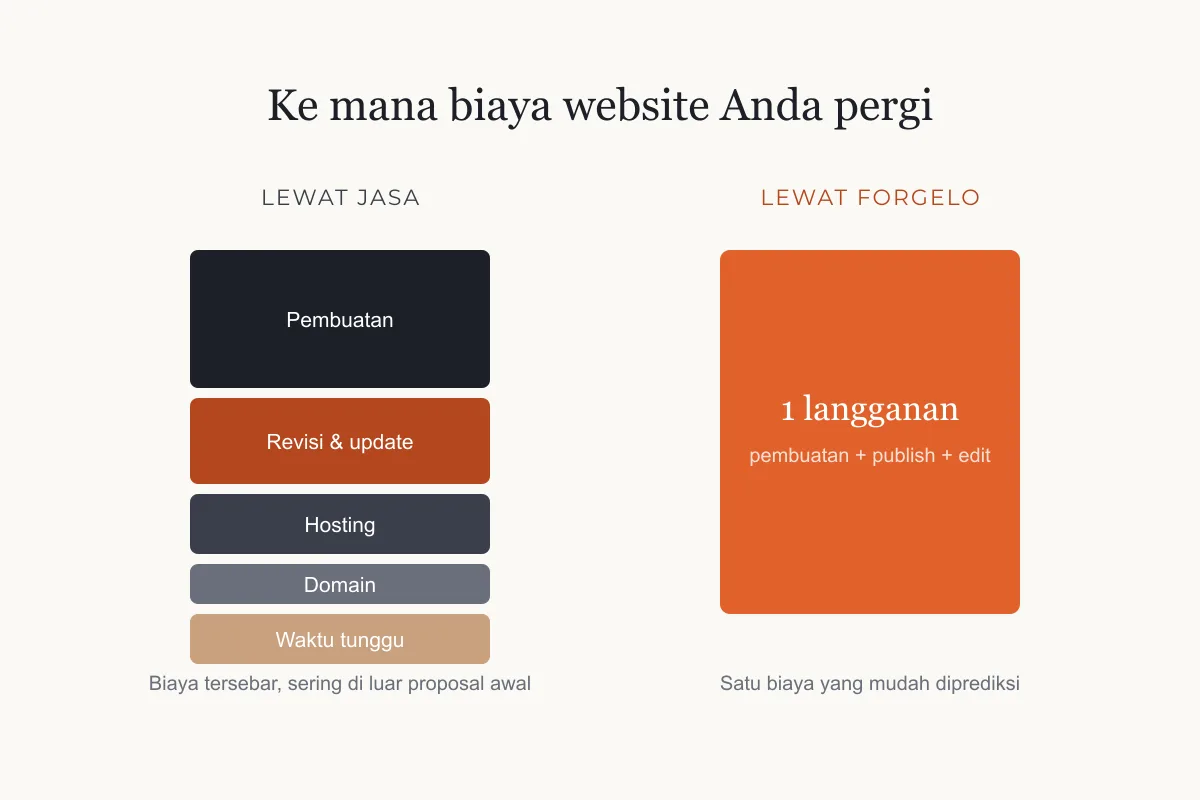
The number in a service proposal usually only shows the build cost. In reality, the total cost of owning your website is more than that. These are the components that are often left out at the start.
- Domain: your site's address, rented per year. The amount is relatively small, but it is still recurring.
- Hosting: where your site lives, paid monthly or yearly. The more traffic you get, the higher the plan.
- Revisions and updates: changes after the site is done are often billed separately, or wrapped into a monthly maintenance package.
- Waiting time: not direct money, but still a real cost. From brief to launch can take several weeks, and during that time your business is not online.
Try adding it all up over one year. Say the upfront build cost is a few hundred dollars, then add annual domain and hosting, plus two or three rounds of content revisions billed separately. The total cost of owning your website in the first year can be far larger than the number written in the proposal. This is the figure you should base your comparison on, not the build cost alone.
What rarely gets discussed is that this revision cost is the one that quietly balloons the most. Every time you want to change a price, add a promo, or update a photo, you go back into the queue and, often, pay again. This is where the AI approach changes the math, because creating, publishing, and the ability to edit are bundled into one subscription.
Why service prices can be that high
It is important to be fair: a high service price does not mean it is expensive for no reason. What you pay for is expertise and accountability, not just the look of a page. A good website builder spends time understanding your business, structuring the pages, writing the content, handling the technical setup, then making sure everything works after launch.
The more specific and complex your needs, the larger the share of expertise required, and the higher the price. A brand design with deep art direction, an integration with internal systems, or a complicated transaction flow all demand a lot of human hours. In our view, it is precisely with complex needs like these that a service price is truly worth it.
The problem is that many small business owners pay a "complex" price for a need that is actually simple. A five-page company profile does not need the team and process of an e-commerce project. When your needs are standard, most of the service fee actually goes to things that can now be automated. If you want to know when a service is truly worth it and when it is not, the guide to website development services in 2026 covers it thoroughly.
A cheaper AI alternative: from one sentence to a website
This is where an AI website builder changes the equation. Instead of writing a brief and then waiting several weeks, you just describe your business in one sentence, and a complete website is built in a few minutes. Not a thin landing page, but a full site with a hero, services, social proof, and a call to action.
Forgelo is designed for people who are not developers, so the flow is deliberately made as simple as possible. You write something like "a coffee shop in Bandung with a menu and ordering via WhatsApp", and the site is forged in a few minutes. What makes it different is that you do not touch code and you do not drag blocks around on a canvas. To change something, you click the part you want to change and type the instruction, for example make the headline punchier or add a price table. Forgelo rebuilds only that part, leaving the rest intact.
The savings come from cutting out labor, waiting time, and revision queues, not just from offering cheaper hosting. Daily control stays in your hands. The website stops being a one-and-done project that then freezes, and turns into something living that you can maintain yourself anytime. You can see the full flow on the how Forgelo works page, or start from a template by industry.
Cost comparison: service vs AI website builder
To keep it concrete, let us line them up directly. The shape of the comparison is consistent, even though the exact numbers are always relative to your needs. For the full head-to-head that weighs speed and control alongside price, see web design service vs AI website builder.
| Aspect | Service (freelancer/agency) | AI website builder (Forgelo) |
|---|---|---|
| Upfront cost | A small fee up to tens of thousands of dollars, one time | Free on a subdomain |
| Recurring cost | Domain and hosting every year, revisions often separate | From about $9 per month when you connect your own domain |
| Time to launch | A few days to weeks | A few minutes |
| How to change content | Send a revision, wait in the queue | Type an instruction, that part is rebuilt |
| Daily control | Through someone else | Directly in your hands |
| Best suited for | Complex and custom projects | Company profile, landing page, small shop, small business |
Notice the "time to launch" row. This is the gap most often underestimated. A business that is online this week can start receiving questions from potential customers, while one still waiting on a first draft from a service has produced nothing yet. Speed is not just about convenience, it is about when your website starts working. If you are curious to compare the cheaper route in more detail, read cheap service vs building it yourself with AI.
When website development pricing is still worth it
This does not mean a service always loses. There are situations where paying a professional is the best decision, and forcing AI would only cause headaches. Lean toward a service if your need fits one of these.
- Custom logic and integration: a site that connects to internal systems, an ERP, or a complicated booking flow. This is a developer's job.
- Deep art direction: a brand that needs a very specific visual identity, custom illustration, or an unusual interactive experience.
- Scale and contractual accountability: a large company that needs an SLA, a security audit, or long-term support with a formal agreement.
- A web app, not a website: when what you actually need is an application with a dashboard, user roles, and complex transactions.
If your need is on this list, the higher service price is worth the result. This is exactly where your money works the hardest. The trick is to be honest in your assessment: do you really need all of that, or is a credible company profile that goes online quickly actually enough?
But honestly, here is what is rarely admitted: many projects sold as complex are not. The extra features that sound impressive often never really get used by customers. Before paying for complexity, ask whether the feature changes how customers contact or buy from you. If the answer is no, you may be paying for something that only looks good in a proposal, not in reality.
How to start saving right now
The most cost-effective strategy is not always choosing the cheapest option, it is matching your need to the right route. Use an AI website builder for standard needs like a company profile, a landing page, and a small shop, then set aside a service budget only for the parts that are truly complex and custom. That way your money does not get spent on things that can actually be automated.
A few practical steps to cut costs without sacrificing quality:
- Start with the free plan first, and only pay when you genuinely need to connect your own domain.
- Use a template by industry as a starting point, then adjust it with instructions instead of starting from scratch.
- Hold off on complex features until there is proof that customers actually need them.
- Split your budget firmly: AI for standard pages, a service only for the custom parts.
The fastest way to decide is to try it yourself. You can write one sentence about your business and watch the finished website appear in a few minutes, free, no credit card required. If it works for you, just connect your own domain with a small subscription. If it turns out your needs really are complex, you now have a clear picture before hiring a service, and your negotiation with a website builder is stronger too.
Try Forgelo for free and turn one sentence into a ready-to-publish website. From prompt to website in a few minutes, then just chat with it to refine.