If you want to know how to make a village website, the hard part is rarely the technology. It is usually the confusion about where to begin: which domain to pick, what content is actually required, and who will keep the thing running once it is built. This guide clears all of that up, from the must-have content to the domain question to the fastest path that gets your village or community site truly live instead of stuck in a planning meeting.
Here is the short version. If you want to launch fast, keep costs low, and have staff who can maintain it themselves, the AI website builder route usually makes the most sense. If your council has a big budget and needs a genuinely complex system, an agency still has its place. Let us walk through each option so you choose deliberately, not by default.
Why a village needs a website at all
A village or community website is not just for looking modern. It does three real jobs that people tend to underestimate.
First, transparency. Local governments are expected to be open about how money is spent. A website is the most practical place to publish the budget, spending updates, and activity reports so residents can see for themselves without a trip to the office. That is not a formality, it is how you build trust.
Second, service. Residents can read how to request a document, what paperwork they need, when the health clinic runs, or how to apply for assistance, at any hour. Staff stop answering the same question over and over on their personal phones.
Third, promotion. Plenty of villages sit on buried potential: tourism, local artisans, produce, cooperative products like coffee, honey, or crafts. A website becomes a storefront that outsiders can find through Google, which reaches far wider than a social media post that sinks out of sight within a day.
Note: An effective village website serves two audiences at once, residents who need service information and outsiders who might become visitors or buyers. Design the menu so both find what they want quickly.
The must-have content for a village website
Before you think about design, lock down the substance. A good village website does not need hundreds of pages. It needs these seven blocks to be complete and genuinely filled in.
| Section | What goes in it | Why it matters |
|---|---|---|
| Village profile | Short history, mission, map and boundaries, population | Introduction and identity |
| Leadership structure | Council, staff, roles, photos and duties | Residents know who to contact |
| Budget transparency | Budget, spending updates, reports | Accountability expectation |
| News and announcements | Events, clinic schedules, assistance info | A living official channel |
| Services | Steps, requirements, and request forms | Makes admin easier for residents |
| Local business and tourism | Attractions, artisans, flagship products | A storefront for outsiders |
| Contact | Office address, hours, WhatsApp number | A clear line of communication |
Pay attention to that contact block. Add a button or form that goes straight to the village WhatsApp. It sounds trivial but the payoff is real, because most residents and would-be buyers are far more comfortable on WhatsApp than email. If you want the broader logic of what any small institution site should include, our rundown of small business website essentials maps over cleanly.

The domain question: official or ordinary?
This is the question that stalls the most projects. The honest answer: use the official government domain (in some countries, Indonesia among them, it is mandatory), but do not let the domain paperwork stall the build for months.
Many regions offer dedicated domains for local governments, addresses that immediately signal a site is the real, official one rather than a personal blog or an impostor claiming to speak for the village. Registering one usually means submitting official documents, such as a request letter and proof of the appointed leadership, through an accredited registrar. The upside is credibility that an ordinary domain cannot match.
But there is a trap that happens constantly. Villages postpone the entire website project just because they are waiting on the domain paperwork. Content work and domain work can run in parallel. The saner move: build the site on a free subdomain first, fill in the content, test it with staff and a few residents, then connect the official domain and announce that address once the paperwork clears. A site that is already alive at a temporary address is far more useful than a perfect one that is still a talking point.
Tip: Start the domain request early, because it usually passes through more than one office, but do not make it a precondition for building. Draft and review the content on a free subdomain first and connect the official domain later without losing anything.
A real example: how Indonesia handles village domains
Indonesia is a useful case because the rules are public and specific. The registry PANDI lists .desa.id among its domain options, but its own page notes that this extension is governed by a ministerial regulation from the ministry in charge of communications, not sold like an ordinary .id name.
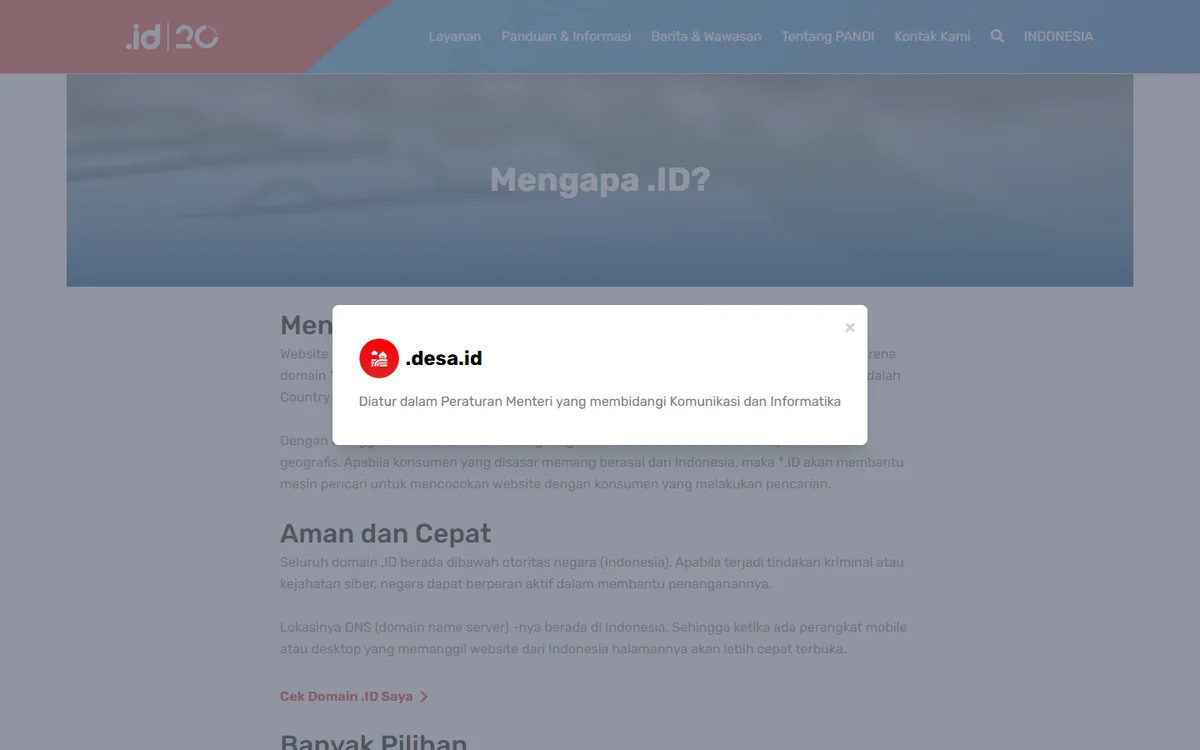
In practice, the application runs through Domain.go.id, operated by the Ministry of Communication and Digital Affairs (Komdigi), which acts as registrar in cooperation with PANDI. Its FAQ cites Ministerial Regulation No. 5 of 2025 as the legal basis and states plainly that village governments must use .desa.id as their official address. The portal counted more than 10,000 registered .desa.id domains on the day we checked.
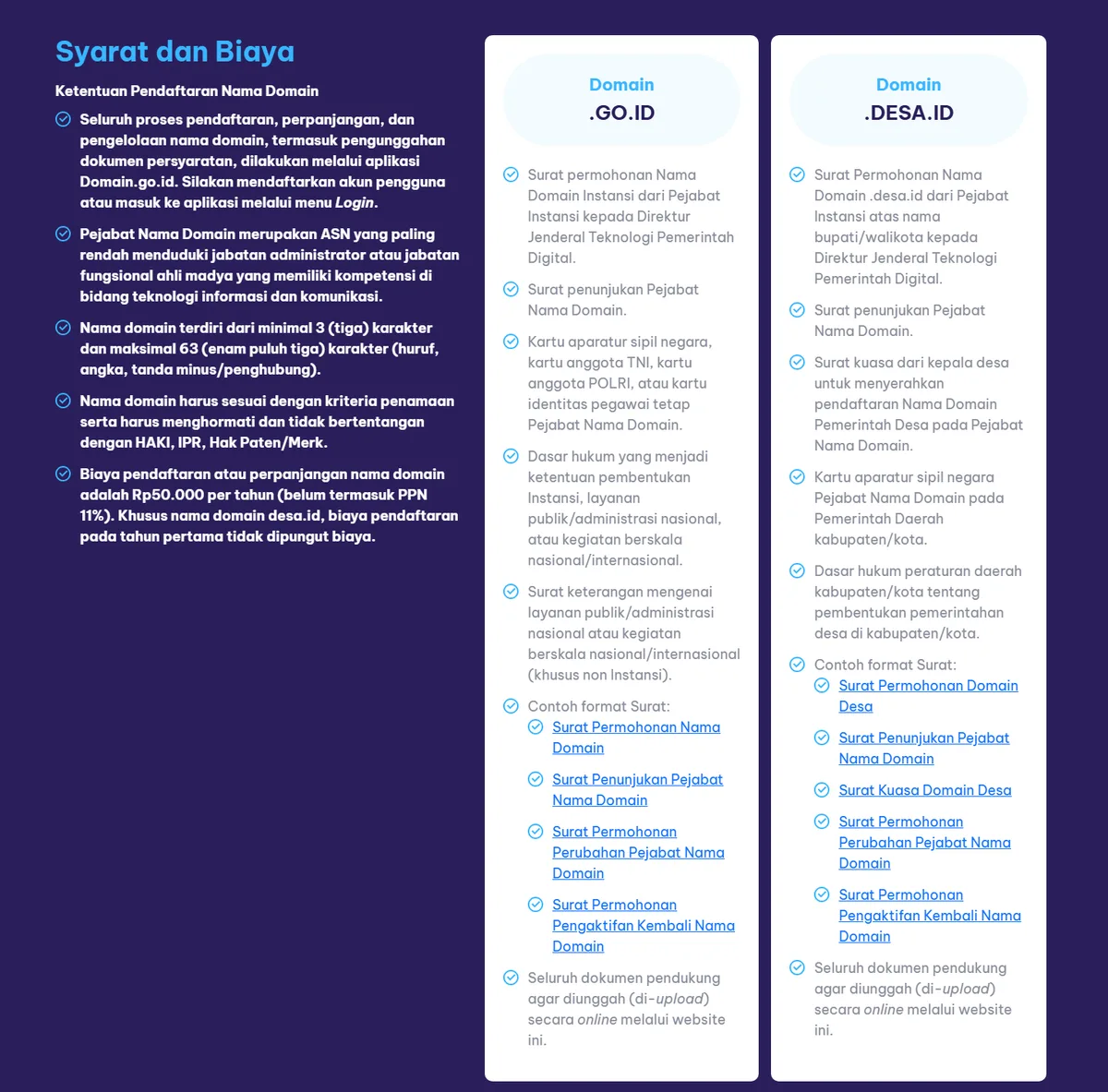
The requirements page lists what a .desa.id application needs. Notice that the village does not apply alone: a domain officer at the district or city government files it on behalf of the regent or mayor.
- A .desa.id request letter from the agency official, on behalf of the regent or mayor, to the Director General of Digital Government Technology.
- A letter appointing the domain officer.
- A power of attorney from the village head handing the registration to that officer.
- The civil servant ID card of the domain officer at the district or city government.
- The district or city regulation that established the village government.
The practical lesson travels well beyond Indonesia: talk to the district IT office first. A 2026 news post on Domain.go.id describes districts such as Bogor and Bandung moving village domains under their communications offices, so the person who can set DNS records for your site may sit at the district, not in the village hall. Connecting a builder to the official address then means asking that officer to add the DNS records the builder gives you.
How to make a village website: three realistic paths
Now the core of it. There are three genuinely realistic ways to make a village website, each with its own trade-offs.
| Path | Rough cost | Time to launch | Who updates it |
|---|---|---|---|
| Agency or contractor | High upfront plus yearly upkeep | Several weeks to months | The vendor, usually per change |
| Free CMS | Low, just hosting and a domain | A few days to weeks | A technical staff operator |
| AI website builder | Affordable monthly subscription | Minutes to hours | Staff themselves, by typing |
The agency route fits when a village needs a truly complex system, say deep integrations with population records, and has the budget plus patience for a long timeline. The downside is that every small update often means emailing and waiting, sometimes with a bill attached.
The free CMS route is solid and widely used, but let us be honest, there is a learning curve. You need an operator willing and able to manage hosting, system updates, and a dashboard that is not always beginner friendly. If that operator moves on or quits, the site tends to get abandoned with them.
The AI website builder route is the lightest to run yourself. You describe the village in one sentence, a full site appears in a few minutes, and editing is as easy as typing the change you want. If you would rather understand the mechanics first, our step-by-step walkthrough on building a website with AI breaks the whole flow down.
How to make a village website for free (or nearly) with AI
For most villages, this is the path I would recommend to start. Here is roughly how it goes.
You begin by describing the village in one sentence, something like "the official website of Sukamaju village, offering resident services, budget transparency, and promotion of local tourism and cooperative products." From that sentence, Forgelo lays out the pages, writes the first draft of the copy, picks the layout, and hands you a site that is ready to publish in a few minutes.
After that you refine it with plain instructions. "Change the head of the village to Mr. Sutrisno." "Add a section for this month's clinic schedule." "Move the WhatsApp button higher." No code, no design software, no waiting on someone else's calendar. Built-in SEO helps the village site show up on Google when people search the village name or its flagship products. The contact form connects straight to the village WhatsApp, so questions land where staff already reply every day.
On the free front, you can publish to a free subdomain first at no domain cost, then connect an official custom domain when you are ready. If you want to weigh other no-cost approaches before deciding, we cover them in how to make a website for free.
Tip: Fill in the three most important sections before you announce the launch, namely the village profile, the WhatsApp contact, and the budget transparency page. Galleries and calendars can follow without holding up the launch.
The mistakes that kill village websites fast
Here is an opinion that may not be popular, but it needs saying: the village websites that fail most are not the ugly ones, they are the ones that stop being updated three months after the ribbon-cutting. A site showing last year's budget, a latest news item dated to launch day, and a stale clinic schedule is actually worse than having no website, because it signals that this place is not being looked after.
The root cause is almost always the same. The website is built by people who are different from the people meant to maintain it. A vendor builds a fine system, then leaves, and staff have no idea how to change anything without calling the vendor back. Because every change means cost and a wait, nobody dares touch it, and the site freezes in time.
So the most important factor when choosing how to make a village website is not just how good it looks on day one, but how easy it is to run yourselves every single week. Pick a method where the operator can change content as easily as sending a message. An easy-to-run site lives for years. A site that needs a developer for every comma dies quietly.
Getting started: from nothing to live
If you want to move today, here is a practical order you can follow without being a technology expert.
- Gather the basics: the village profile, leadership structure, an official WhatsApp number, and the latest budget figures.
- Assign one operator, ideally a staff member who is comfortable with a phone and everyday apps.
- Build the site with an AI website builder, describe the village in one sentence, let the structure generate itself.
- Edit by typing: fill the seven must-have sections, tidy the copy, add the WhatsApp button.
- Publish to a free subdomain as a staging address for review by staff and a few residents.
- Handle the official domain in parallel with the district IT office, connect it as a custom domain, and announce only the official address.
- Schedule routine updates, for instance weekly announcements and budget reports whenever there is new spending.
You can review the plans and subscription costs on the pricing page to confirm it fits the village budget. The important thing is not to wait for everything to be perfect. Get a basic version live, then add piece by piece. To help the site actually get found once it is up, our primer on website SEO basics is a good next read.
Making a village website is not a one-shot project that has to be flawless on day one. It is a working tool that grows with the community. Start simple, make sure you can run it yourselves, and let the site expand as the village gathers more stories worth sharing.