A website increases sales for a small business when it does four jobs well: it brings in relevant prospects, explains the product's value quickly, builds trust, and makes the next step easy. A website is not an automatic sales machine just because it is live. It becomes a sales tool when its structure, content, and contact path follow the way customers make decisions.
For many Indonesian small businesses (known locally as UMKM, micro, small and medium enterprises), that final step does not have to be a checkout. Customers may need to ask about stock, sizes, service areas, schedules, or custom orders. WhatsApp is the everyday business channel in Indonesia, so a website that routes its lead form straight to WhatsApp can fit better than a form that ends up in an email inbox. The owner receives the prospect's context and continues the conversation in the channel they already use all day.
This article walks through the system from start to measurement. You can apply it to a food business, home services, a repair shop, a salon, a clinic, crafts, catering, consulting, or any other local business without being a developer.
Contents
- Why a website can increase small business sales
- Build the sales foundation before chasing traffic
- Structure pages that turn visits into leads
- Bring in visitors who intend to buy
- Measure and improve results regularly
- Frequently asked questions
Why a website can increase small business sales
A website gives prospects one place to understand the business without waiting for an admin to reply. They can see products, price ranges, service areas, examples of work, reviews, opening hours, and how to order. Complete information cuts basic questions and helps people judge whether your offer fits.
Its role differs from social media and marketplaces. Social media is strong at earning attention and building interaction. Marketplaces make it easy to sell standardized products. A website brings your identity, offer, proof, and conversion path together in a space you control. Instead of choosing one, use the website as the destination for your bio, ads, business profile, business card, QR code, and social content.
A website also makes the sales process more consistent. The best explanation no longer depends on who happens to be handling the chat. Every visitor sees the same key benefits, service limits, answers to doubts, and call to action. Your team can then focus its time on conversations that genuinely need a human.
Still, the link between visits and sales is best seen as a flow:
- Someone finds a page relevant to their need.
- The page headline confirms they are in the right place.
- The offer explains outcomes, not just a list of features.
- Proof reduces the perceived risk.
- A button or form offers an easy next step.
- The business responds, assesses the need, and closes the sale.
If any stage is weak, more traffic will not necessarily help. A thousand confused visits can be worth less than a few dozen visits with a clear need and a smooth contact path.
Build the sales foundation before chasing traffic
Before changing the design or writing articles, set one main goal for the website. Pick an outcome close to revenue, such as requesting a quote, booking an appointment, scheduling a consultation, checking stock, or buying. A goal like "look modern" can support it, but it is not enough to guide page decisions.
Here is the foundation to write down first.
Define your priority customer. Avoid targeting "everyone". Write down who needs the product most often, the problem they have, the area you serve, and why they would buy now. Daily catering for offices needs a different message from catering for family parties, even from the same kitchen.
Write your core offer. In one or two sentences, explain what you sell, who it is for, the outcome they get, and a difference you can prove. "Laundry service" is too generic. "Pickup and delivery laundry for apartment residents in Depok, with weight and price confirmed on WhatsApp" gives a picture someone can act on.
Reduce risk. List the five doubts that come up most often in sales chats. Examples include quality, punctuality, shipping costs, minimum order, warranty, or payment security. Answer them on the page with facts. Do not make claims like "number one" or "most trusted" without proof.
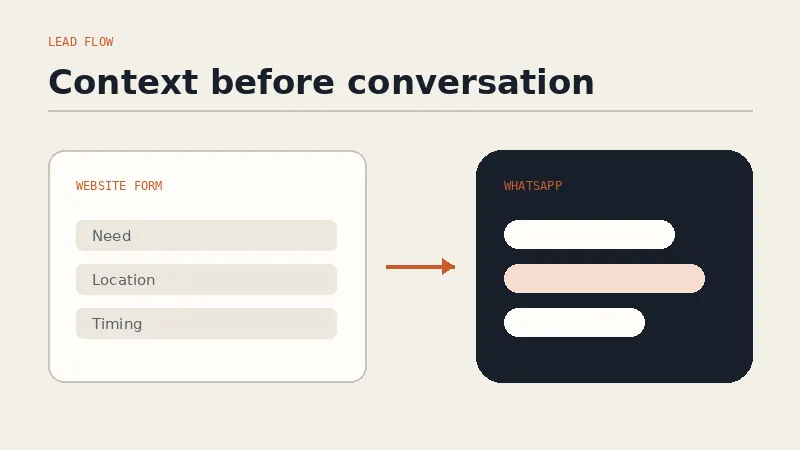
Choose one main conversion. If buying requires a discussion, use a short form that asks only for essentials. Name, need, location, and preferred time are often more useful than a long form. Once submitted, forward those details straight to WhatsApp so the conversation starts with context, not "how can I help you?".
Set up a response routine. Decide who receives leads, response hours, the format of the first reply, and how status is recorded. A website can open the door, but sales still leak when messages are answered late or never followed up. Create simple categories such as new lead, needs info, quote sent, follow-up, won, and not proceeding.
If you do not have a site yet, start with the guide on how to build a website for your business. Prioritize a first version clear enough to test, not a big project waiting for perfect materials.
Structure pages that turn visits into leads
An effective sales home page follows the order of a prospect's questions. They want to know what you offer, whether it suits them, why they should trust you, roughly what commitment is involved, and what to do next. The structure below is a good starting point.
Opening section. Write a headline that names the outcome or product category concretely. Add a supporting sentence, the service area if relevant, and one main button. Skip "welcome to our website" openers, because they do not help anyone decide.
Problem and outcome. Show that you understand the customer's situation, then describe a realistic outcome. Focus on the change they will feel. A packaging maker, for example, can explain size options, minimum quantities, and design help, not just the types of machines it uses.
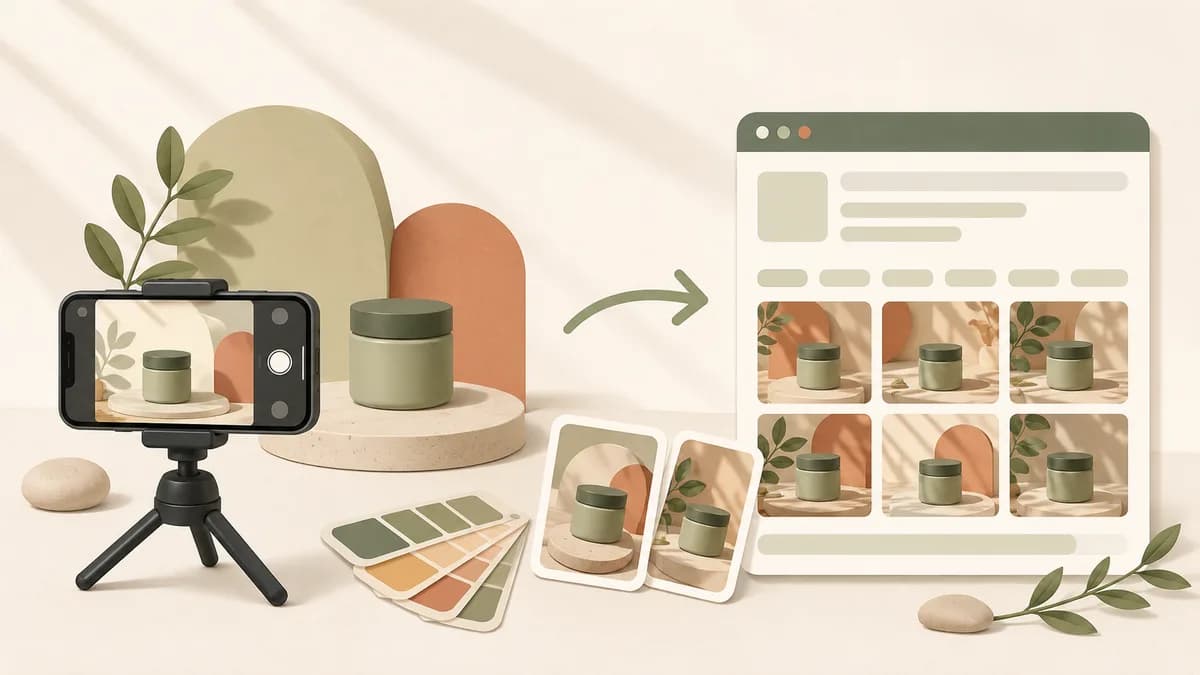
Products or services. Group options so they are easy to compare. Include real photos, scope, a starting price or how to get a quote, an estimated timeline if it is certain, and important limits. Transparency filters out poor-fit leads and makes conversations more productive.
Trust proof. Use real testimonials, photos of results, short case studies, business identity, policies, or detailed answers. Make sure you have permission to use testimonials and photos. Specific proof persuades more than a row of generic claims.
FAQ and call to action. Answer objections right before the final button. Repeat one main call to action with a clear verb, such as "Get an estimate on WhatsApp" or "Check available dates". Visitors should never have to hunt for your contact number.
Review the mobile experience too. Buttons should be easy to tap, text easy to read, images should not cover information, and forms should be comfortable to fill in. Test the whole flow yourself, including the message that arrives in WhatsApp. Do not rely on the desktop preview alone.
For small business owners, the biggest hurdle is often not building the first version but keeping it updated. Prices, promotions, service areas, and product photos change. With Forgelo, non-developers can select one section and write a prompt such as "change the second package to a monthly service" or "shorten the testimonials section". The change applies to that section only, so you never touch code or rebuild other pages. Lead forms can also go straight to WhatsApp so the page and the sales process stay connected.
Bring in visitors who intend to buy
Once the conversion foundation is ready, bring prospects in from suitable channels. Do not wait for SEO to do the work alone. Share specific pages through social profiles, your Google Business Profile, sales conversations, proposals, relevant communities, print materials, and ads when the economics make sense.
For organic search, create pages around real needs. A page for "on-call AC service in Bekasi" is more targeted than an "our services" page. Product catalogs need the names customers actually use, unique descriptions, relevant photos, delivery areas, and buying information. Articles can answer pre-purchase questions and then point readers to the right service.
Google's official Search Essentials and SEO starter guide stresses content that is useful to readers, a logical site organization, and descriptive titles and links. For a small business the practice is simple: one page serves one main intent, the title names the topic honestly, navigation connects related pages, and content is written to help prospects, not to repeat keywords excessively.
For local search, complete your business profile with accurate, consistent data. Google's official documentation explains that local results are based mainly on relevance, distance, and prominence, and recommends complete, accurate business information. See Google's guide to improving your local ranking for steps that apply to your profile. Do not promise specific positions, because search rankings cannot be guaranteed.
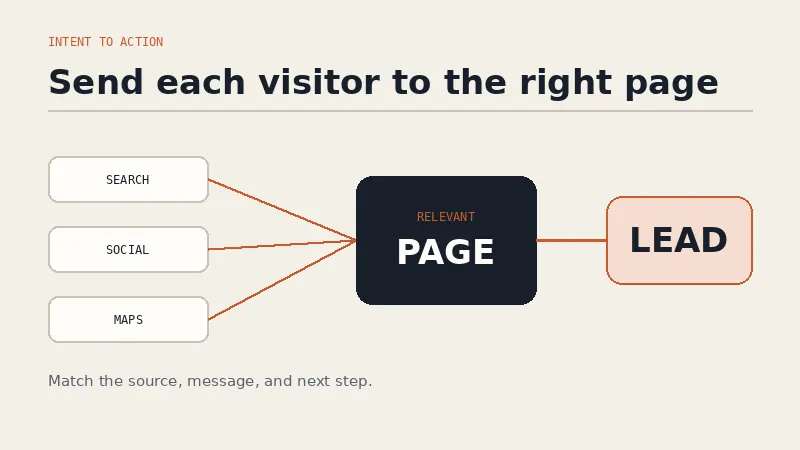
Each channel should lead to the most relevant page, not always the home page. An ad for a meeting catering package should open the meeting package page. A kitchen renovation portfolio link should open examples of kitchen projects. Alignment between the source, the page, and the call to action reduces confusion.
Avoid buying traffic before the lead flow has been tested. Start with the visits you already get, watch their questions, fix the page, then increase distribution. That way your budget scales a flow that works instead of paying more people to hit the same problem.
Measure and improve results regularly
Success is not measured by visitor numbers alone. Build a chain of metrics that follows the path to revenue:
- visits to product or service pages;
- WhatsApp button clicks;
- successfully submitted forms;
- leads that meet your criteria;
- quotes sent;
- completed transactions;
- sales value from website leads.
Record the lead source with campaign parameters or a short question in the form. When a transaction happens, tag its original source. This simple data helps you separate channels that bring readers from channels that bring buyers.
Use ratios carefully. If many people view a page but few get in touch, check the clarity of the offer, the proof, the pricing, and the call to action. If many forms arrive but the leads do not fit, clarify your target, area, minimum order, or price range. If leads are good but few buy, the problem may be response speed, the follow-up offer, availability, or the sales process, not the website.
Make one important change at a time so its effect is easier to read. For example, make the headline more specific, add a price range, move a case study closer to the call to action, or shorten the form. Allow enough time to collect data for your traffic volume. Small businesses with low traffic should also use qualitative insight from chats and customer conversations instead of forcing conclusions from a small sample.
Schedule a monthly review. Test every button and form, update stock or services, replace outdated information, review new questions, and see which pages produce leads. Because Forgelo supports section-by-section editing by prompt, owners can make small improvements without waiting for a developer. Easy editing matters because a sales website is not a one-off brochure, it is an asset that follows changes in the business.
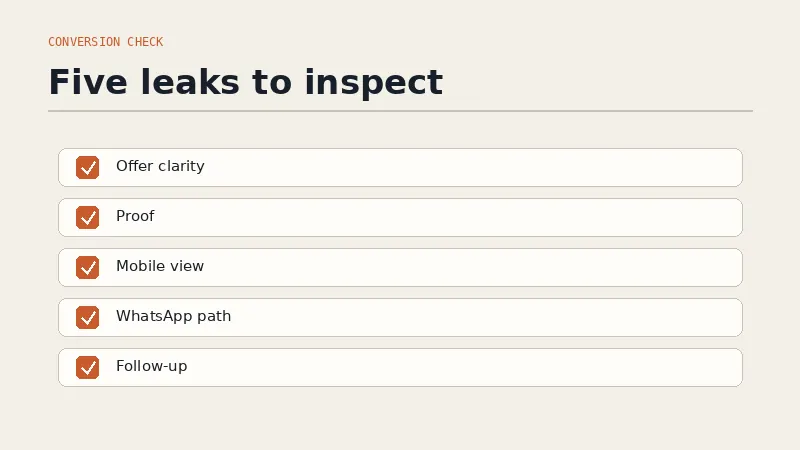
Use this checklist before adding features:
- Do visitors immediately understand the product and who it is for?
- Is there real, relevant proof?
- Are pricing, process, area, and key limits clear enough?
- Is the main call to action visible on mobile?
- Does the form ask for just enough information?
- Do leads reach a WhatsApp number that is actively monitored?
- Can every transaction be traced to its source?
Once these seven are working, then consider extra features. Complexity does not always raise sales. Clarity and disciplined follow-up are usually worth more.
Frequently asked questions
How does a website increase sales for a small business?
A website connects a prospect's need with a clear offer, trust proof, and a next step. The effect comes from the whole flow, from the page being found to the lead being followed up, not from simply having a website.
Does a small business still need a website if it already has social media?
Yes, because they do different jobs. Social media distributes content and builds interaction, while a website is the information and conversion hub the business controls. Send social audiences to the page that matches the content or promotion they saw.
Does a small business website need an online store?
No. Use a checkout when the product, price, shipping, and transaction process are standard. For services or custom orders, a clear catalog plus a lead form that goes straight to WhatsApp can be a more natural flow.
How long until a website starts producing sales?
There is no timeline that applies to every business. A website can receive leads once it gets visitors, but results depend on demand, traffic quality, the offer, trust, response, and the sales process. Avoid anyone who guarantees revenue or rankings within a set time.
How do I measure whether the website is helping sales?
Connect visits, WhatsApp clicks, forms, qualified leads, quotes, and transactions. Record the source of each lead and the value of completed transactions. That way, improvement decisions are based on contribution to sales, not traffic alone.
What is the best first step?
Pick one offer, one customer type, and one main action. Build or tidy one page for that combination, connect the lead path to WhatsApp, then test it on a phone. Once the flow works, bring in visitors and fix whatever raises the most doubt.
A website increases sales when it clarifies the decision and shortens the distance between interest and conversation. Start with one focused page, measure real results, and update it step by step. If you want to run that process without coding, see Forgelo's features, then adjust each section by prompt and send leads to the WhatsApp number you monitor.