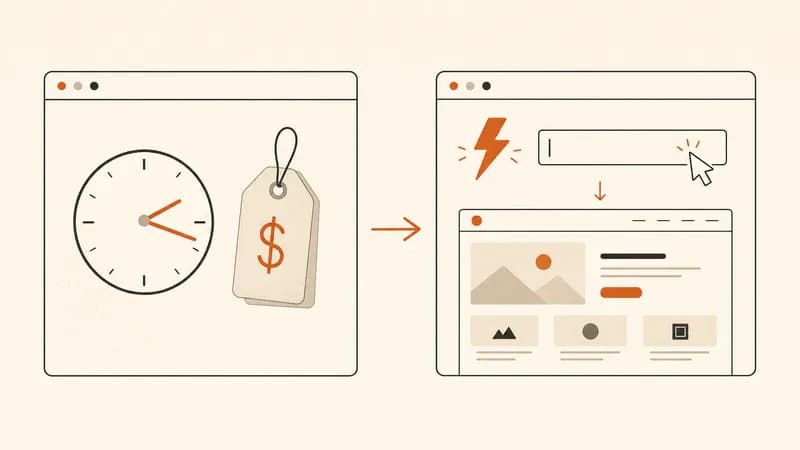
For most standard business sites, an AI website builder is easier than WordPress because setup, hosting, design, and routine editing sit in one managed workflow. WordPress remains the more flexible choice when you need specialist plugins, deep code access, or a complex store. That is the honest verdict in an AI website builder vs WordPress comparison: the easier option depends on whether your site is mainly pages or a custom system.
WordPress powers a substantial part of the web and has an exceptionally broad ecosystem. Mature AI website builders, however, now offer a faster and less expensive route for standard business needs: describe the business in one sentence, then direct edits through prompts. If you are still mapping the wider category, our best AI website builder comparison explains which capabilities actually matter before you choose a product.
The short answer is straightforward. If you need a company profile, service site, catalog, portfolio, or lead form and want to update it yourself, AI will often make more sense. WordPress services remain stronger for genuinely complex builds, large stores, and requirements that depend on specialist plugins.
When should you choose WordPress and when should you choose AI?
Choose a WordPress service for a large WooCommerce catalog, plugin-dependent features such as memberships or online courses, unusual integrations, or full control of code and hosting. Choose an AI website builder when you need a credible business site online quickly, have a limited budget, and want to update it yourself without waiting for a developer.
Choose WordPress services for a large WooCommerce catalog, plugin dependent functions such as membership or learning management, unusual integrations, or full control of code and hosting. Choose AI when you need a credible business site online quickly, have a limited budget, and want to update it without a developer.
Many small businesses fall into the second group. Their real requirement is not unlimited flexibility, but a polished website that is simple to maintain. Paying for WordPress flexibility that will never be used can add cost and complexity. Website development services vs AI website builders compares the broader decision beyond WordPress.
Use a requirements test before comparing platforms
Write down what a visitor must be able to do on launch day. A local accountant might need service pages, staff profiles, testimonials, a contact form, and appointment links. An international training company might need student accounts, protected lessons, recurring payments, certificates, and reporting. The first brief is a standard marketing site and suits either route. The second contains application style requirements that favor WordPress with proven specialist plugins or a custom system.
Then separate launch requirements from possible future ideas. Score each confirmed requirement for revenue impact, urgency, and technical difficulty. Do not buy a complex stack today because someone may request a membership area in three years. Conversely, do not force an AI builder to support a critical workflow it was not designed to handle. This short exercise turns a vague platform preference into an auditable business decision.
What are WordPress website services?
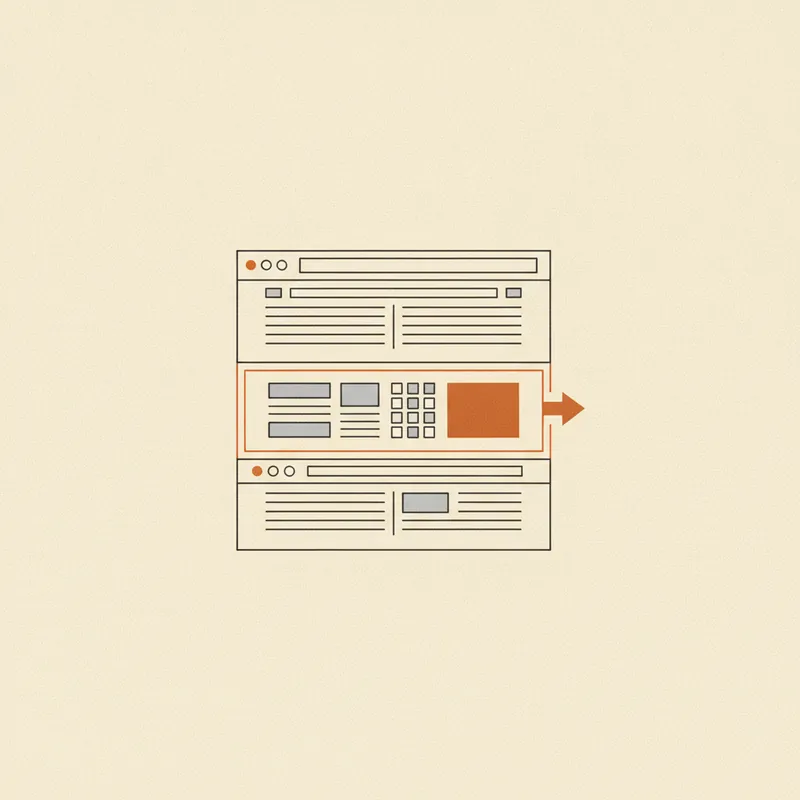
A WordPress website service is a project where a freelancer or agency builds your site on WordPress, the open source CMS. It usually covers choosing or customizing a theme, installing plugins, configuring hosting, entering content, testing, and handover. The ecosystem is powerful, but hosting, premium licenses, backups, security, and updates continue after launch.
WordPress is open source software supported by a large global ecosystem. A WordPress service normally includes selecting or customizing a theme, installing plugins, configuring hosting, entering content, testing, and handing over the website.
Its ecosystem is a genuine strength. Thousands of themes and plugins support requirements ranging from WooCommerce stores to complex forms. That power has continuing costs: managed hosting, premium licenses, backups, security, and maintenance. Themes, plugins, and WordPress itself require updates, and neglected components can create security problems. Our website development services guide covers the commercial side in more detail.
Building with AI: how does it work?
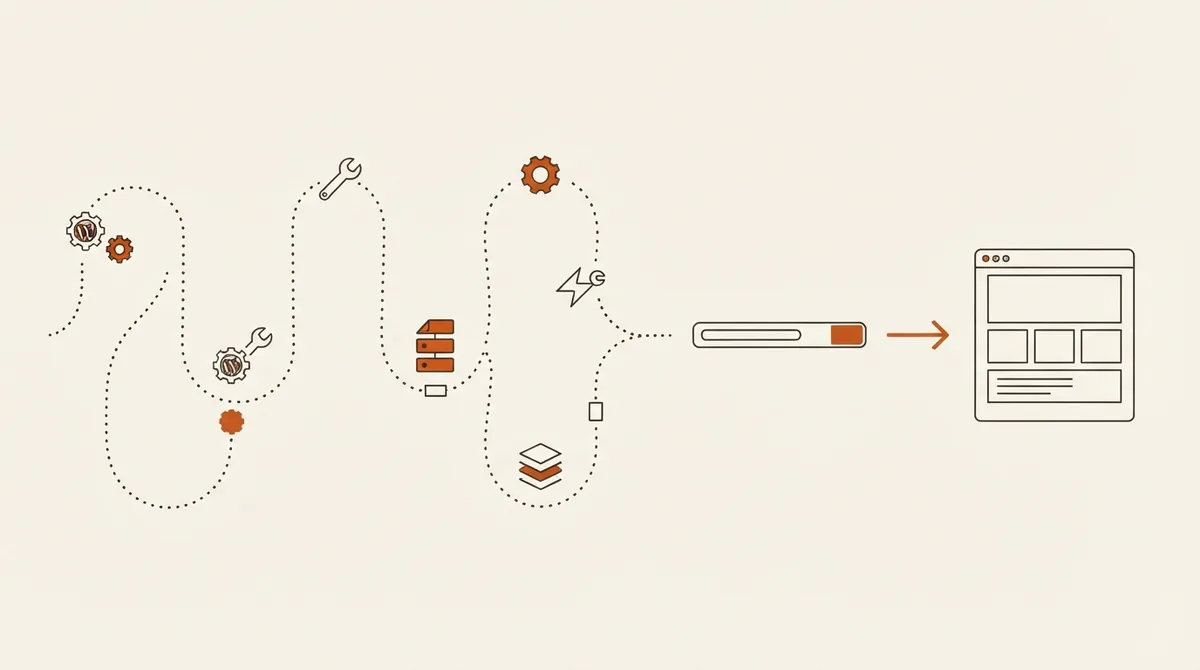
An AI website builder reverses the traditional process. Rather than choosing a theme and arranging blocks, describe the business and receive a complete structure containing a hero, services, proof, and contact sections. See how Forgelo works.
Forgelo's key difference is section level prompt editing. Generation is not a one time result. Select one section, type a request such as "make this headline more direct," "turn these offers into a pricing table," or "add a WhatsApp button," and only that section is rebuilt. Strong sections remain untouched.
This is not a developer code generator or an exhausting visual canvas. It is a self service platform for non technical owners. You provide direction and business facts, while AI handles construction. If this is your first site, build a website without coding is a calm starting point.
An honest comparison: WordPress vs building with AI
Neither route wins every case. The table highlights their practical differences.
| Factor | WordPress website services | Build with AI |
|---|---|---|
| Time to launch | Several days to weeks | Minutes |
| Initial cost | Hundreds to many thousands of dollars | Start free, then subscribe |
| Editing method | Editor, plugin, or developer request | Type a prompt and rebuild one section |
| Maintenance | Regular core, theme, plugin, and security updates | Handled by the platform |
| Extreme flexibility | Very high, with thousands of plugins | Focused on common business sites |
| Large stores | Strong through WooCommerce | Best for small to medium catalogs |
| WhatsApp leads | Available through plugins | Forms can send directly to WhatsApp |
| Best for | Complex projects, large stores, plugin requirements | Small businesses, services, landing pages, small stores |
Compare both options against the same brief
A fair comparison gives each supplier or platform the same pages, functions, content volume, languages, and launch date. For example, ask for a five page service site with a contact form, analytics, basic search optimization, a custom domain, and two rounds of content changes. A low WordPress quote that excludes copy entry, mobile testing, or maintenance is not directly comparable with a managed builder subscription that includes those items.
Test editing as well as the first build. Ask one non technical team member to change a price, replace a photograph, add a testimonial, and publish a temporary campaign banner. Record the time taken, any support needed, and whether the result remains consistent on mobile. This reveals the operational cost that feature lists miss. Also check accessibility, page speed, domain ownership, data export terms, backups, and what happens when a subscription or maintenance agreement ends.
Which costs more over time, WordPress or an AI builder?
WordPress usually costs more over time. After the project fee you keep paying for hosting, domain renewal, premium licenses, maintenance, and developer changes. An AI builder starts free on a subdomain and moves to a predictable subscription, with no fee per content revision because you make edits yourself. Compare both on a three-year total.
A website's cost is the total paid while it remains useful. WordPress begins with project fees and continues with domain renewal, hosting, premium licenses, maintenance, and developer work for changes outside the agreement. A business that frequently updates menus or promotions may spend more on those later changes than on the original build. See website service pricing for the cost model.
An AI builder reverses the pattern. You can start free on a subdomain and subscribe when you need a custom domain or paid features. There is no separate fee for each content revision because you make it yourself. For many small businesses, annual cost becomes lower and more predictable. Current details belong on the pricing page.
Build a simple three year cost estimate
Put every expected expense into one worksheet. For WordPress, include discovery and design, development, content migration, hosting, domain renewal, premium theme and plugin licenses, backups, security monitoring, routine maintenance, and an allowance for developer changes. Ask whether taxes, payment processing, stock images, email services, and emergency support are included. Costs vary by country and supplier, so a transparent local quote is more useful than a universal headline price.
For an AI builder, include the subscription tier, domain renewal, any usage limits, additional mailboxes, and optional professional help for copy or branding. Estimate internal time for both routes. If an employee spends four hours every month coordinating changes, that effort has a cost even when no invoice arrives. Finally, model a likely redesign or migration rather than assuming the first site lasts forever. Comparing total ownership over three years prevents a cheap launch from hiding an expensive operating model.
How fast can each option get a site online?
An AI builder gets a site online in minutes, while a managed WordPress project normally takes days or weeks. With Forgelo, one business sentence becomes a complete website in a few minutes and can be published on a free subdomain immediately. Either way, a responsible launch still needs accurate details, working forms, and a mobile review.
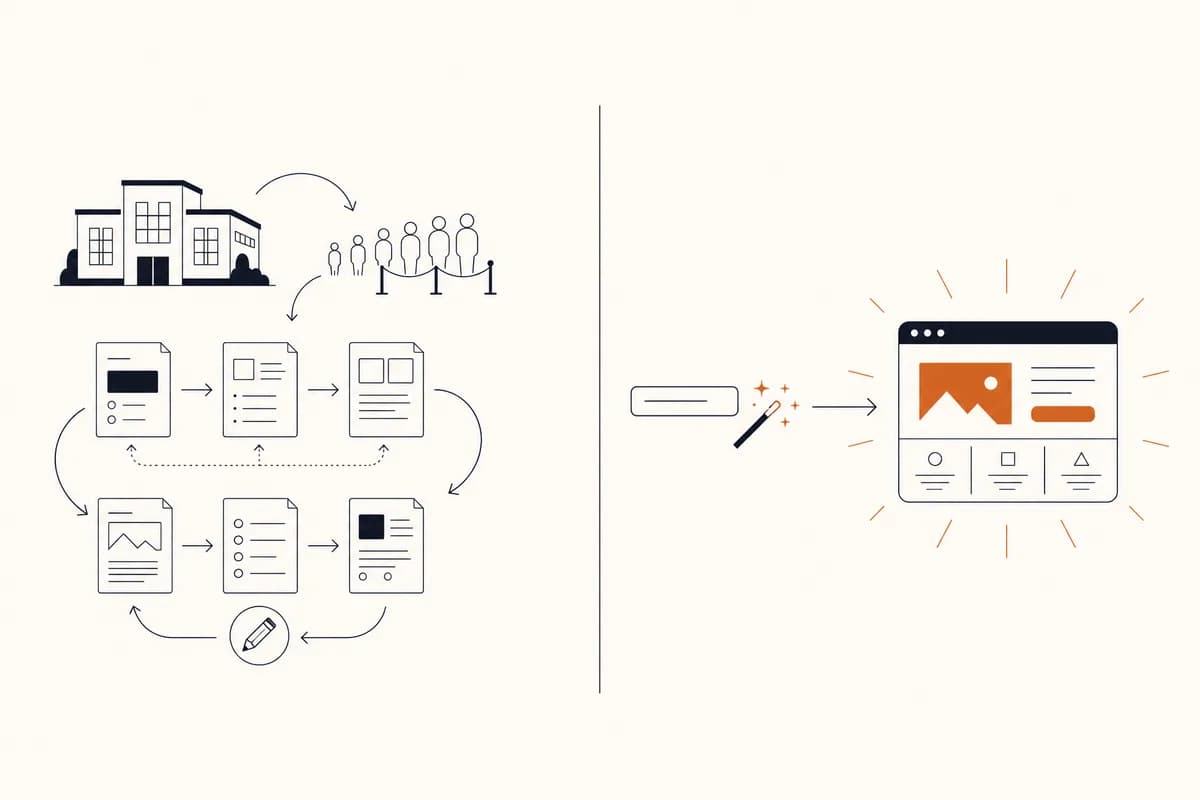
A managed WordPress workflow includes discovery, theme and plugin setup, content entry, technical configuration, testing, and revision. Even an efficient supplier will normally need days or weeks.
With Forgelo, one business sentence becomes a complete website in a few minutes and can be published on a free subdomain in minutes. That difference matters before an event, campaign, launch, or time sensitive offer. Section level prompt editing then makes revisions immediate rather than a new queue.
Measure readiness, not generation speed alone
The first generated page is only a draft. A responsible launch still requires accurate contact details, approved claims, original images or properly licensed alternatives, working forms, privacy information, mobile review, and basic analytics. Regulated businesses may also need legal or compliance approval. Use the same readiness checklist whether the initial layout took minutes or several weeks.
AI still compresses the production stage because structure and revisions happen quickly. WordPress can be equally efficient when the brief, assets, and decision makers are ready, but supplier scheduling and technical setup add dependencies. Compare the date when a verified customer can complete the intended action, not the date when someone first shows a homepage mockup.
Who handles maintenance, updates, and security?
On WordPress, someone on your side or your agency must update the core, themes, and plugins, test backups, and fix conflicts, or the site becomes fragile. A managed AI builder handles infrastructure, platform updates, and security for you. Your team still owns content accuracy: offers, opening hours, legal notices, and answering incoming leads.
WordPress core, themes, and plugins need regular updates. Old plugins can become security risks, backups need attention, and compatibility issues can appear after changes. Cheap projects often become fragile because responsibility after handover was never clear.
A managed AI builder handles infrastructure, platform updates, and security. There are no themes or plugins for the owner to patch. Daily control remains with you: select a section and ask to change the headline, add proof, update pricing, or move the primary action. Unlimited flexibility is valuable only if you need it. For many owners, safe self service maintenance has greater practical value.
Define ownership after launch
Before choosing WordPress services, identify who monitors updates, tests backups, renews licenses, checks forms, and fixes conflicts. Confirm response times and whether restoring a failed site costs extra. If an agency handles everything, request a written maintenance scope and access credentials owned by the business. If your team handles it, assign a named person and a recurring schedule rather than relying on good intentions.
With a managed AI builder, the provider owns more of the technical layer, but the business still owns content accuracy. Someone must review old offers, team changes, opening hours, legal notices, and incoming leads. Check support channels, service terms, custom domain controls, and content portability. Managed infrastructure removes many technical chores, not accountability for the customer experience.
When WordPress services make more sense
WordPress is the stronger choice for a large online store with hundreds or thousands of products, where WooCommerce and its integrations are mature. It also fits plugin centered requirements such as paid membership, online courses, publishing workflows, and complicated booking systems. If you hire a supplier, use the website service selection checklist to evaluate the proposal.
WordPress also makes sense when your team requires full code and server control and has specialists available to maintain it. Be honest about whether the flexibility is essential or merely attractive in theory. AI website builder vs web designer can help clarify the boundary.
When building with AI is better
AI is a strong fit for company profiles, service pages, catalogs, portfolios, campaign landing pages, and lead generation. Forms can direct prospects to the channel where the business actually responds. Our guide to turning visitors into WhatsApp leads covers that route.
It is especially useful for a business that changes often. New offers, prices, products, and proof can be updated in minutes through section prompts. The page stays current instead of waiting several revisions behind the business. See low cost website services vs building with AI for another practical comparison.
How to start building your website with AI
First, write one specific sentence, such as "an independent coffee shop in Boston with seasonal menus, subscriptions, and online table booking." Second, generate the complete draft. Third, refine one section at a time with prompts. Fourth, publish on a free subdomain and connect your domain when ready. For a full step-by-step of the business route, see how to build a website for your business, or start with building a website without coding for complete beginners if this is your first project.
Start from an industry template if useful, learn website SEO basics, and consult Google's SEO Starter Guide. Review Core Web Vitals on web.dev for performance principles. Local businesses should also maintain a Google Business Profile.
Give the AI concrete facts and constraints
A useful prompt states the audience, location or service area, main offer, desired action, proof, and tone. For example: "Create a clear five page site for a residential solar installer serving Melbourne. Emphasize accredited installers, written warranties, and a free assessment. Use plain English and direct visitors to request a quote." Replace every generated placeholder and verify every factual claim before publishing.
Refine one outcome at a time. Ask for a shorter headline, a service comparison, a clearer form introduction, or a stronger proof section, then review the whole page on desktop and mobile. Avoid a broad instruction such as "make it better," which gives the system no objective. Specific prompts create more predictable edits and make approval easier for a team.
Conclusion
WordPress website services and building with AI are both valid, but for different jobs. WordPress leads for large stores, specialist plugins, and deep customization. AI leads on speed, predictable cost, managed maintenance, and simple self service editing, which are often the priorities of small service businesses.
Choose based on real complexity, not popularity. If the requirement is standard and you want control without revision fees, build the first version yourself. With Forgelo, one business description creates a complete site in a few minutes, and every section can be refined through prompts. Start free and upgrade after the website proves its value.