
Choosing a real estate website builder starts with one question most comparison lists skip: do you need live MLS search on your site, or do you mainly need to market your own listings and win enquiries? The answer splits the market in two. Specialised real estate platforms are built around listing feeds. General builders with a property template are faster and cheaper for agents who sell their own stock, focus on one area, or work outside the US.
This guide explains that split, the pages a real estate website needs, how to capture and handle leads, what each route costs, and how to launch a property site quickly without code. It is written for independent agents, small agencies, property developers marketing a project, and landlords with a few units to let.
Two kinds of real estate website builder
Before comparing features, decide which kind of site you are building.
The first kind is a search portal. Buyers come to search the whole market in your area, filter by price and bedrooms, and save homes. In the US, this usually relies on IDX. According to the Wikipedia entry on multiple listing services, the National Association of Realtors set policies that let brokers show limited MLS information on their websites under a system known as IDX, or Internet Data Exchange. To use it you need MLS membership and a provider approved for your MLS, and the platforms that offer it tend to be specialised and priced accordingly.
The second kind is a marketing site. It shows your own listings, your local knowledge, and your track record, and its main job is to get a buyer or seller to contact you. Many agents in markets without a shared MLS, many developers selling a single project, and agents who rely on portals for search traffic only need this kind.
| Question | If yes | If no |
|---|---|---|
| Do buyers expect to search every listing in your area on your site? | Look at real estate platforms with IDX for your MLS | A marketing site with your own listings is enough |
| Do you have more than a few dozen active listings at a time? | Consider a listing feed or a dedicated platform | Manual listing sections are manageable |
| Do you sell in one project or one neighbourhood? | A focused marketing site usually converts better | Broader search may help |
| Do you want to launch this week on a small budget? | Start with a general builder and a property template | A specialised platform may fit later |
Many agents end up with both: a portal or brokerage site for search, and their own marketing site for their name, their area, and their best listings.
The pages a real estate website needs
Whichever route you choose, the same pages do most of the work.
| Page | What it does | What to include |
|---|---|---|
| Home | Says where you work and what to do next | Area served, a strong photo, featured listings, one clear action |
| Listings | Shows what is available | Property cards with photo, price, location, beds, baths, size |
| Property page | Sells one home | Gallery, key specs, description, map area, viewing request |
| About | Builds trust | Your story, track record, testimonials, licence details where required |
| Area guides | Wins local search | Schools, transport, amenities, typical property types |
| Contact | Starts the conversation | Short form, phone or WhatsApp, office hours, response time |
A small agency can start with home, listings, about, and contact, then add property pages and area guides as listings and time allow.

Start from a property template
A property template saves the hardest part of the job: deciding the layout. It already has a search-style hero, listing cards, and an enquiry form in the places buyers expect them.
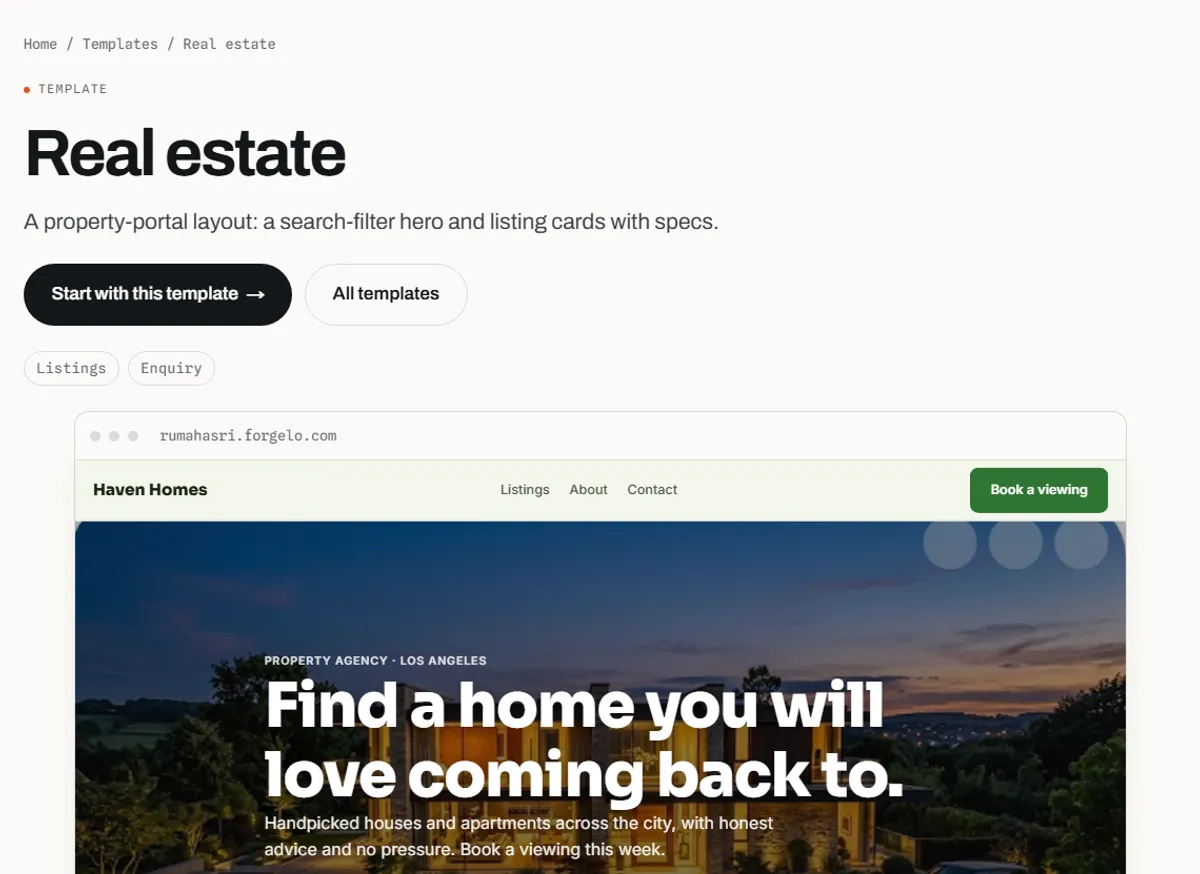
Forgelo's Real estate template is described as a property-portal layout with a search-filter hero and listing cards with specs. The demo agency is fictional, so you replace the name, the area, the photos, and every listing with your own. The structure, a strong opening image, a short promise, and a "Book a viewing" button in the header, is what you keep.
Listings that make buyers click
Listings are the reason most visitors arrive. Each card should let a buyer decide in a glance whether to look closer.
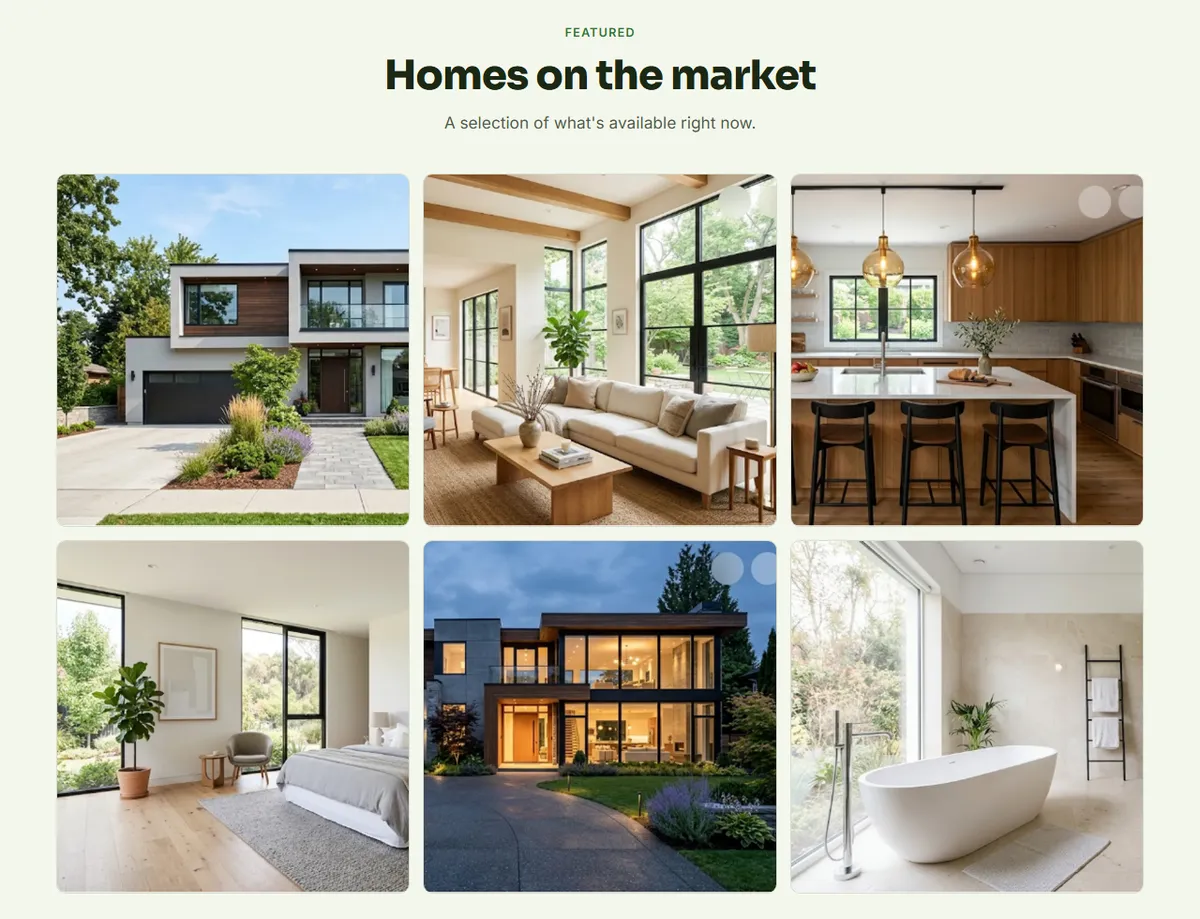
Good listing cards and property pages share a few habits:
- Lead with the best photo, usually the exterior or the main living space, taken in daylight.
- Show the price or a clear "price on request" note. A clear price helps buyers qualify themselves before they contact you.
- Put key specs on the card: location, bedrooms, bathrooms, and land or floor size.
- Write a short, honest description that mentions what buyers ask about, such as parking, orientation, and nearby schools.
- End every property page with one action, such as "Book a viewing" or "Ask about this home".
Use your own photos or photos you have the right to use. Copying images from another agent's listing or a portal creates copyright and trust problems.
Capture leads and book viewings
A real estate website earns its keep when a listing turns into a conversation. Buyers often contact several agents at once, so speed and simplicity matter more than clever design.

Keep the form short: name, a phone or WhatsApp number, budget range, and a free-text field. A budget dropdown helps you qualify buyers before you call. Place a viewing request on every property page and a general enquiry form on the contact page.
Then reply quickly. If your buyers prefer chat, route enquiries to WhatsApp. Forgelo sites can send lead form submissions and contact buttons to WhatsApp, as described in the WhatsApp lead forms help article. Our guide on how to turn visitors into WhatsApp leads covers the follow-up side.
Comparing your options
Here is how the main routes compare for an agent or a small agency.
| Option | Best for | Strengths | Trade-offs |
|---|---|---|---|
| Specialised real estate platform | US agents who need IDX search | Listing feeds, saved searches, CRM features | Higher monthly cost, more setup, design often generic |
| Custom build by an agency | Larger agencies with a brand and a budget | Full control, bespoke features | Highest upfront cost, slow changes, ongoing developer costs |
| General drag-and-drop builder | Agents who enjoy design work | Flexible layouts | You build every page and listing block by hand |
| AI website builder with a property template | Agents and developers who want to launch fast | Draft in minutes, edit by typing, low monthly cost | No MLS or IDX feed; listings are sections you edit |
That last point is worth stating plainly: Forgelo does not connect to MLS or IDX feeds. Listings on a Forgelo site are content sections you add and edit yourself, which suits agents with a manageable number of listings, single-project developers, and markets without a shared MLS. If live search across the whole market is essential, a specialised platform is the better fit, and a Forgelo site can still serve as your personal marketing page.
How to build a real estate website without code
With an AI builder, the process takes an afternoon once your photos and listing details are ready.
- Describe your business in one sentence, for example "Independent agent selling family homes in North Austin, focused on first-time buyers".
- Start from the property template or let the AI generate a draft from your description.
- Add your listings by typing them in: "Add a listing: three-bedroom house, two bathrooms, 1,800 square feet, price on request".
- Connect enquiries to your email or WhatsApp and check the form on your phone.
- Publish on a free subdomain or connect your own domain.
If you have never used an AI builder before, how to build a website with AI walks through the process step by step, and our AI website builder guide explains how these tools differ.
What a real estate website costs
Costs fall into three buckets: the platform, extras, and your time.
Specialised real estate platforms and IDX providers charge monthly fees that vary widely by market and feature set, so check current pricing directly with each provider. Custom builds carry a project fee plus ongoing developer costs. On Forgelo, the Free plan is $0 and publishes one site on a Forgelo subdomain, Starter is $9 per month, Pro is $19 per month, and Business is $39 per month, as listed on the pricing page. A custom domain is bought separately.
Your time is the largest cost. Professional photos, accurate listing details, and a few good area guides take far longer than the build. For a wider comparison of budgets, see how much a website costs.
Local SEO for real estate websites
Most property searches are local, so local signals carry the most weight:
- Area guides for each neighbourhood you serve, with real detail about schools, transport, and housing types.
- A consistent name, address, and phone number on your site and your business profiles.
- One page per featured property, with a descriptive title such as "Three-bedroom family home near Riverside Park".
- Fast, mobile-friendly pages, because many buyers browse listings on a phone.
- Fresh content: remove sold listings and add new ones promptly.
Our guide to website SEO basics covers titles, descriptions, and structure, and small business website ideas shows how other local businesses structure their sites for enquiries.
Common mistakes on real estate websites
Leaving sold listings up. Nothing loses a buyer's trust faster than enquiring about a home that sold months ago.
Poor photos. Dark, crooked, or phone-zoomed photos make good homes look bad. Buyers judge a listing by its photos before they read a word.
Long enquiry forms. Every extra field costs enquiries. Ask only what you need to call back.
No clear area. "Your trusted property partner" says nothing. "Family homes in North Austin" tells buyers instantly whether you fit.
Slow replies. Buyers contact several agents. The first useful reply usually wins the viewing.
Bottom line
The best real estate website builder is the one that matches how you sell. If live MLS search is essential, choose a specialised platform with IDX for your market. If your job is to market your own listings and win enquiries, a property template on a general builder gets you live faster and for less. Either way, the winning formula is the same: clear area, honest listings with good photos, one action on every page, and fast replies. To try the quick route, start with the Real estate template and edit it by typing.